Modernism and “Authentic Architecture” at the 1935 Taiwan Colonial Exposition
This exhibition is presented in three rooms: Room 1 presents how Taiwan had previously been exhibited to Japan and the West and the design inspirations for the 1935 fair; Room 2 presents the tension between modernism and “authentic architecture” used during the fair; and Room 3 presents the legacy of modernism and memory of Japanese colonialism after the fair. The exhibition presents primarily architectural representations in photographs and postcards, but also uses maps and other materials in visual culture to illustrate these points.
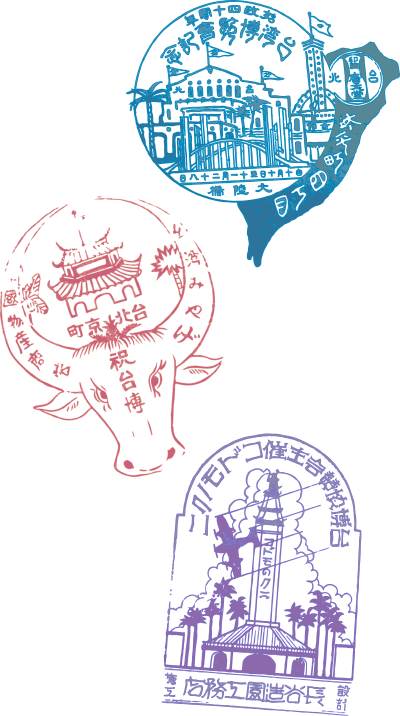
Various claims of “Taiwanese-ness” can be detected in the architectural expressions used by Japan to promote Taiwan to different audiences. Since the Meiji Restoration in 1868, Japan had only been actively participating in Western world’s fairs but also held various national industrial fairs to promote industry and the arts. After the acquisition of Taiwan in 1895, the matter of how to present Japan’s first formal overseas colony came into question.
In these earlier expositions, so-called “Taiwan pavilions” constructed by Japanese authorities were designed along authentic lines, using Taiwan’s vernacular architectural vocabulary as a signifier for Taiwaneseness— in these cases, the Minnan or Southern Fujian style used by the Han Chinese population—to create a tantalizingly exotic ambience in order to promote agri-industrial products from the island, such as tea and camphor.
On the island colony itself, however, the tone shifted dramatically. Authenticity became less of a concern and modernism became the predominant look. The 1935 Taiwan Colonial Exposition to commemorate the 40th anniversary of Japanese colonial rule, was the largest such exhibition to be held on the island. The fair was a monumental event, held in numerous sites across the island through efforts not only from colonial authorities but also from wealthy local merchant organizations, attracting nearly three million domestic and international visitors over the course of two months. Contrary to Taiwan’s image presented in industrial fairs in mainland Japan and the West, authenticity was less of a concern in the 1935 Exposition. Since the audience was mainly the colonized Taiwanese population, the fair was overwhelmingly modernist in outlook in order to promote to its audience the modernizing progress and benefits of Japanese colonial enterprise.
The 1935 Exposition promoted products from the island and propagandized colonial achievements through various exhibition venues across the island, but the focus was on the colonial capital city of Taipei (Taihoku). The three fairgrounds in Taipei had pavilions exhibiting commercial goods, cultures from Taiwan, Japan, and other colonies, and held performances and festivals. It is in these venues that the tension between the authentic and the modern also played out. How did the colonial authority present Taiwan as modern but also preserve local culture at the same time? Do the colonized Taiwanese have agency in their self-presentation? How do these architectural discussions continue after the fair?
Exhibition Rooms
Exhibition Curator
Meng-Hsuan Lee
PhD Candidate, Department of Art History and Archaeology, Columbia University
Designed by