Asian Voices at the World Parliament of Religions
Room No. 2: The Events of the Parliament
Pung Kwang Yu 彭光譽
(1844-1899)
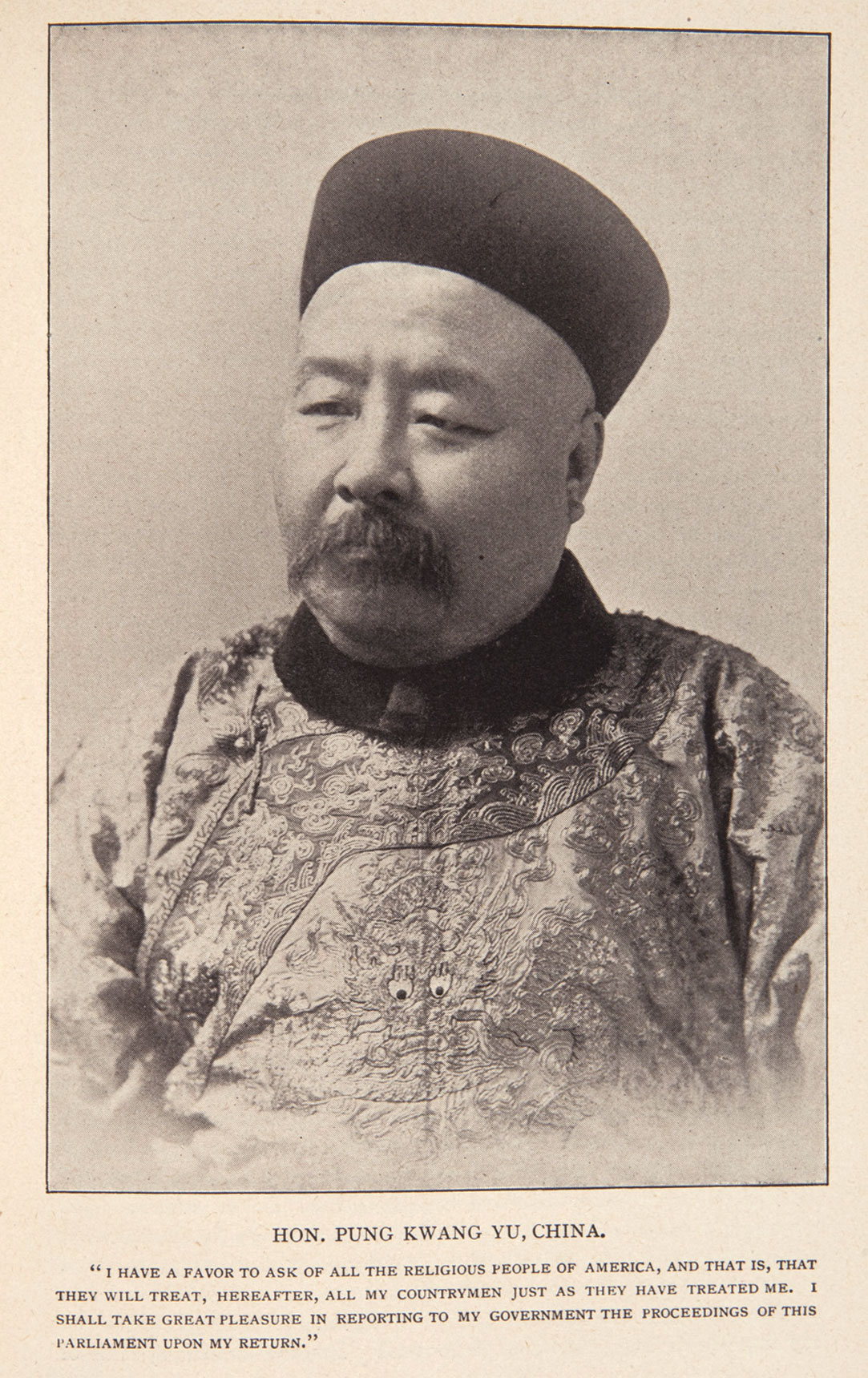
Hon. Pung Kwang Yu, diplomat from the Chinese Legation in Washington, D.C., who was invited to speak on Confucianism at the Parliament. (Source: John Henry Barrows, The World’s Parliament of Religions (1893), Vol. 1, plate following p.376).
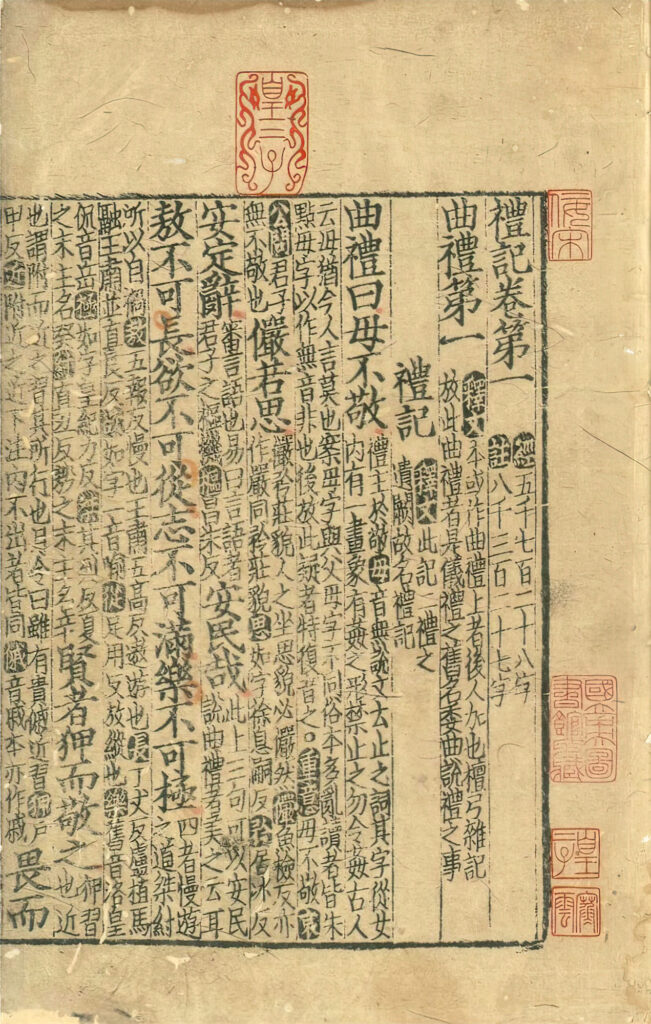
Sample page from an annotated edition of Li Ji 禮記, The Book of Rites, one of the Five Classics of the Confucian canon. (Source: Library of Congress 2021666359)
Confucianism
The Honorable Pung Kwang Yu used the program’s topic “What the World’s Religions Reported in Regard to the Nature of Man” as a perfect opportunity to proclaim the humanistic orientation of the Confucian tradition.
Pung began with Confucius’s commentary on the Book of Rites that explains that human beings are the union of heaven and earth. Their natural faculty is “humanity” and their controlling emotion is “love.” For Pung, the ethical orientation that makes people human was connected to the moral framework of the universe itself.
From the idea of “humanity,” Pung expanded into a discussion of social relationships and filial duty. He mentioned the Confucian golden rule, “Do not do unto others whatsoever ye would not that others should do unto you,” and stressed the importance of ritual or “propriety” as an expression of humanity.
Further developing these ideas of God and spirits, he concluded by illustrating Confucius’s attitude toward the spirits, using the well-known passage from the Confucian Analects: “We have not yet performed our duties to men, how can we perform our duties to spirits?”
Barrows’s summary of Pung’s presentation begins with two points that had enormous significance for the interpretation of Confucianism in the later American study of religion. First, Pung questioned whether it makes sense even to call Confucianism a “religion.” He noted that popular religious movements in China often brought calamities to the country and have been shunned by Chinese intellectuals.
Pung agreed with Western scholars who argue that the ethical system of Confucius cannot be called a religion. He also expressed grave skepticism about the concept of “God” that was so central to the American organizers of the Parliament. Whatever parallels may have existed between Chinese and American views of the deity ran aground on basic questions, such as the role of God in creation and Confucius’s commitment to ethical cultivation in this world rather than concern for the world of gods and spirits.
Pung’s Comments on Chinese-American Relations

Like other Asian representatives, Pung was not just concerned about matters of religion. He also had strong political views and wanted to make them known to his American audience. In his farewell remarks to the Parliament, he gave an emotional appeal to treat his Chinese countrymen in America with the same courtesy that the Parliament audience had shown to him.
After reading Pung’s address, Barrows made explicit the political significance of this point, saying that “the words of this distinguished Chinese diplomat would be imparted to the Government, and it was to be hoped that they would result in destroying the obnoxious Geary law,” referring to the draconian anti-Chinese immigration law of 1882 that embittered relations with China until late into the twentieth century.