Asian Voices at the World Parliament of Religions
Room No. 2: The Events of the Parliament
Moments of Tension at the Parliament
Although the delegates to the Parliament were expected to treat each other with tolerance and respect, there were notable moments of tension between Christian and non-Christian delegates. One incident that caught the attention of the media involved the Rev. George Pentecost of London, who claimed “that among the high caste Brahmins of India there were at least 600 priestesses who were known as immoral or profligate,” adding that “There are two or three Oriental bubbles which have been floating over Chicago for the last two or three weeks which need to be pricked.”1
Similar complaints were voiced by a Christian former missionary to India. Several months after the Parliament, Presbyterian minister Henry Simpson Lunn was invited to preach at Dr. Barrows’ Presbyterian church in Chicago on Indian religions in response to Swami Vivekananda’s presentations at the Parliament and across America. As reported in the local press, Lunn reportedly described Hinduism as “…the incarnation of vice…its pantheon was an incarnation of the worst vices of humanity, …[and] its temple worship was disgraced by obscene rites of the vilest character, that the actual sacred shrines were ornamented by pictures and carvings of such a disgraceful nature that it was necessary to protect them by a special clause in an act entitled Campbell’s act, passed in 1856, as otherwise their obscenity would have brought them within range of the law…”2

Swami Vivekananda’s criticism of Christian missionaries in India. Chicago Daily Tribune, September 21, 1893, p. 10.

Description of the audience reaction to comments by Rt. Rev. Reuchi Shibata, a Shinto priest from Japan, that were critical of Christian missionary activities in Japan. Chicago Daily Tribune, Thursday, Sept. 14, 1893.
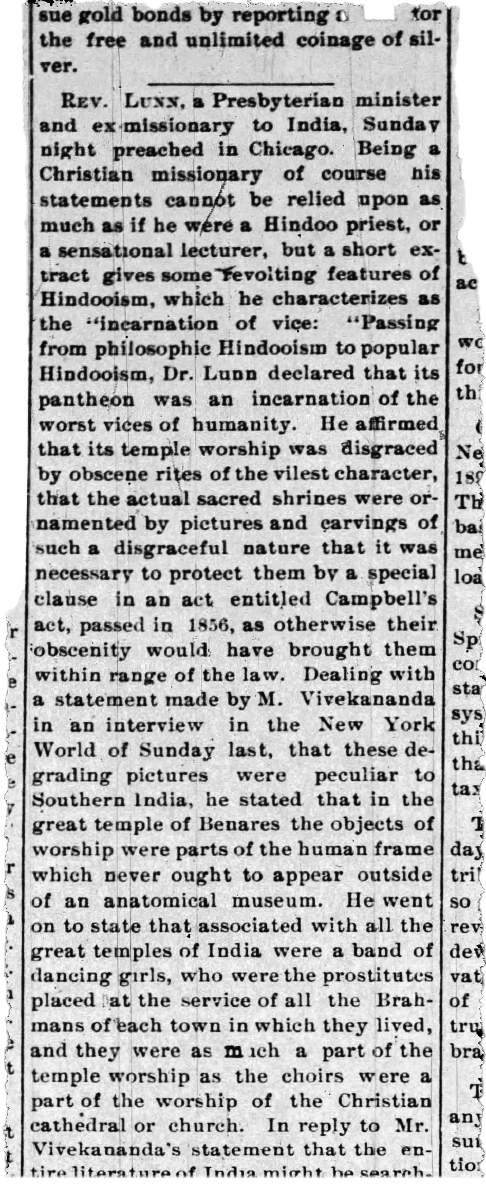
Rev. Lunn’s harsh critique of Vivekananda and Hinduism, as reported in The Streator Free Press (Streator, Illinois) February 15, 1894, p. 4.
Both the audience and the delegates reacted to Pentecost’s comments. Dr. Virchand Gandhi said that he “considered it beneath his profession as a member of the Jain faith to stoop to the depths which the Rev. Mr. Pentecost had reached,” adding that “the Oriental bubbles might be found heavier than certain bloated balloons of self-conceit which were temporarily obscuring a large portion of the horizon.” This implied that the wisdom expressed by the Asian delegates had been more weighty than the wisdom of Dr. Pentecost’s Christian compatriots, despite their inflated presence at the Parliament.
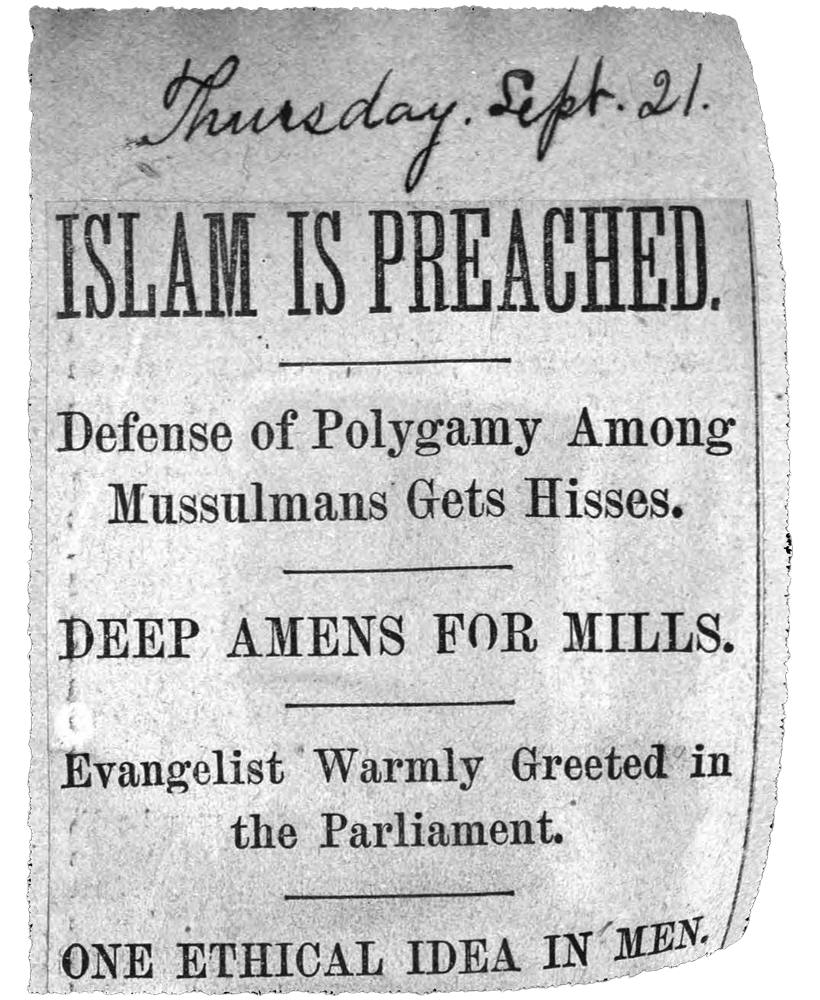
Another critical comment came by Joseph Cook, a Protestant representative from Boston. As described in the Chicago Daily Tribune, Mr. Cook said “The result of that comparison of faiths [at the Parliament] has convinced us that Christianity has a rival in no religion.”3 He made a particularly critical comment about Dr. Mohammed Webb, a Muslim delegate, who attempted to defend polygamy to the Chicago audience. In addition, Cook went on to criticize “child wives in the East and the priestesses in India.”4 Cook felt that many of the non-Christian delegates had “kept the seamy side of non-Christianity out of sight.”
“Islam is preached. Defense of Polygamy among Mussulmans gets hisses.” Chicago Daily Tribune, Thursday Sept. 21, 1893.
Cook’s comments were criticized by some members of the American press. One example, in the words of the Springfield Journal, lamented that
It is a sad commentary on professed Christians that all the intolerance thus far exhibited in the Parliament of Religions has come from them, and not from the “heathen” for whom they were wont to express so much scorn. These scholarly foreigners were invited here to express their views and are entitled to the fullest courtesy. They should be protected from the insults of Joseph Cook and other opinionated bigots.5
Another writer from the Elgin Every Saturday (Elgin, IL) said that the Christian delegates’ overall behavior made it appear as though “civility and charity were not characteristic of the Christian religion and commented that Joseph Cook’s remarks in particular were “bigoted” and “ill-bred.”6
Footnotes
- “Gandhi in a Reply: Answer to Mr. Pentecost’s Attack on the Hindoos,” Chicago Daily Tribune, September 26, 1893, p. 9. ↩︎
- The Streator Free Press (Streator, Illinois), Thursday, Feb. 15 1894, p. 4 ↩︎
- “Cook on the Results: Indicates some of the Issues of Religious Parliament,” Chicago Daily Tribune, October 2, 1893. ↩︎
- “Cook on the Results: Indicates some of the Issues of Religious Parliament,” Chicago Daily Tribune, October 2, 1893. ↩︎
- “Religious Congress,” Chicago Daily Tribune, September 25, 1893. ↩︎
- “Religious Congress,” Chicago Daily Tribune, September 25, 1893. ↩︎