Asian Voices at the World Parliament of Religions
Room No. 2: The Events of the Parliament
Anagarika Dharmapala
(1864-1933)
Criticism and Discussion of Missionary Methods
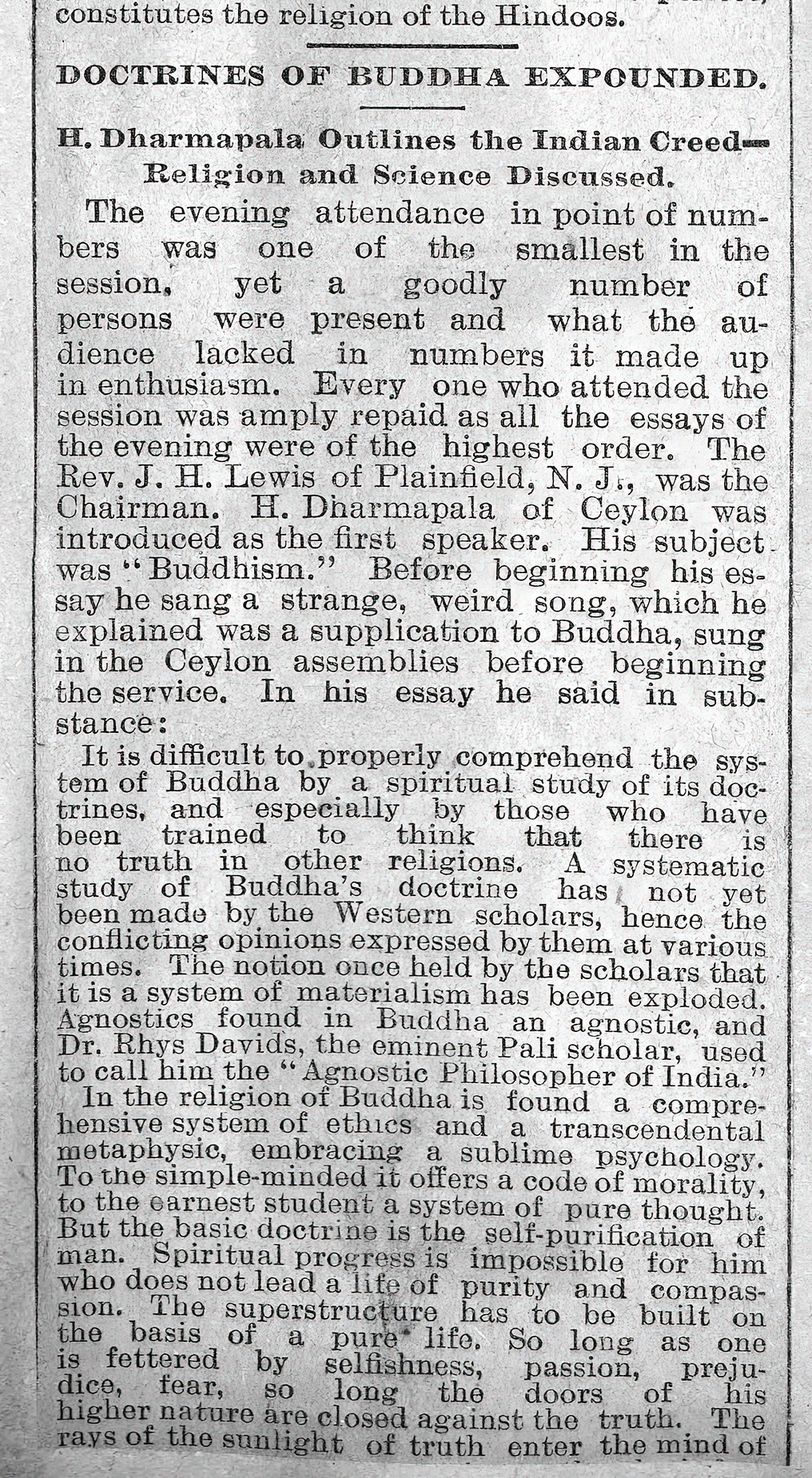
“Doctrines of Buddha Expounded. Dharmapala Outlines the Indian Creed,”
Chicago Daily Tribune, 20 Sept 1893, p. 10
Dharmapala gave a short speech as part of a series of addresses by several delegates about Christian missionary methods. His remarks were straightforward and arguably curt. He declares that missionary methods over the last three centuries have been largely unsuccessful in the East. He credits that to the missionaries themselves that have been sent. He says that on the whole, the missionaries sent to Asian countries have been “intolerant” and “selfish” and that as a result of this, intelligent natives are reluctant to interact with them. Only low types of people, he argues, have become their converts.
In addition, he brings up another equally important point but with little elaboration. When comparing the work of Buddhist and Christian missionaries, he says that the Buddhists were successful in spreading their religion all over Asia, and in making people “mild” in temper as a result. However, the work of Western civilization, he claims, “is undoing their work.” Finally, he addressed the younger generation of Christians in attendance to suggest that the only way Christianity can become widespread in Asia is if they follow the principles of “Christ’s love and meekness.”
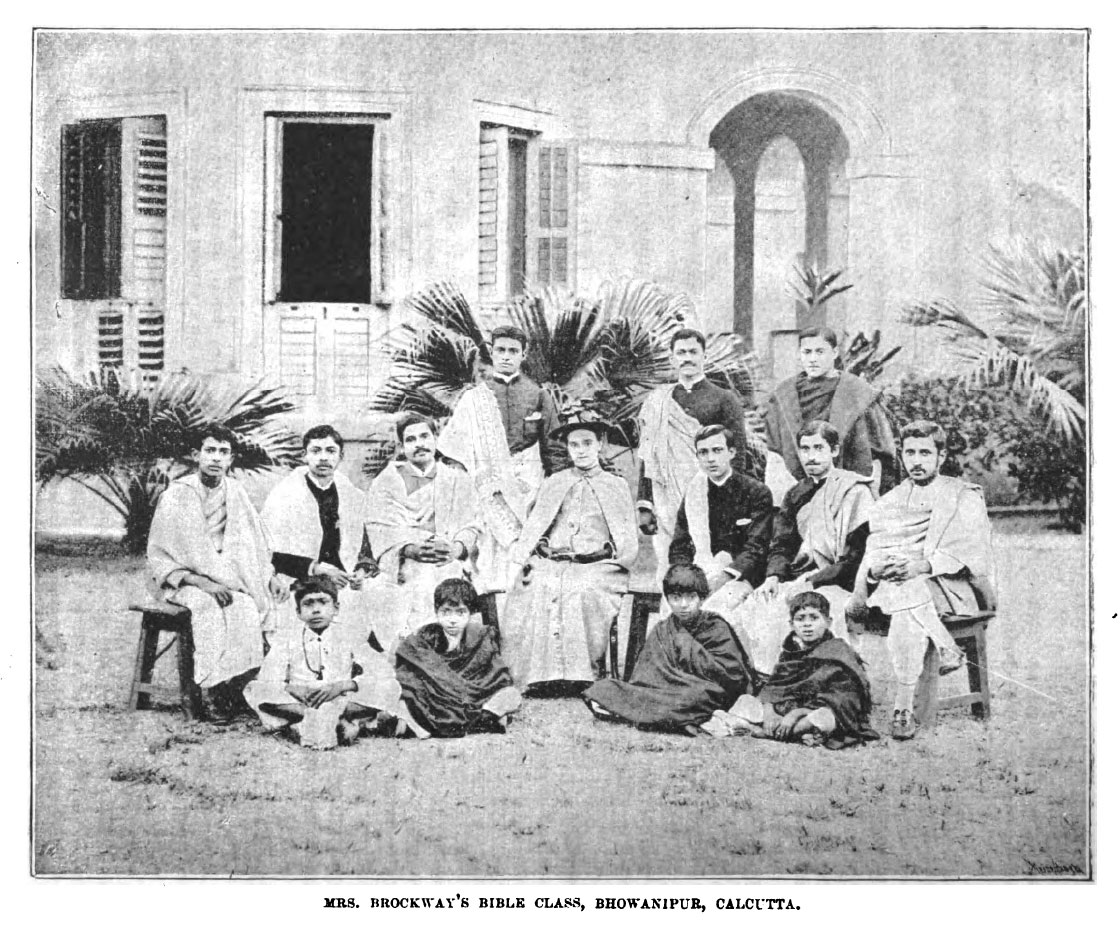
Mrs. Brockway’s Bible Class, Bhowanipur, Calcutta. Chronicle of the London Missionary Society 1, January 1892, p. 9.
Points of Resemblance and Difference Between Buddhism and Christianity

As the title implies, Dharmapala’s second speech is a comparison of Buddhism and Christianity. He begins the discussion by comparing the Buddhist and Christian approaches to inequality among men, stating that Buddhism explains this phenomenon through one’s actions in his or her past and present life, thereby eliminating the need for “interference of a personal God.”
In contrast, he says that Christianity deals with these injustices through the promise of rewards in the future, ostensibly speaking about the prospect of ascension into heaven. His real emphasis is on Buddhism’s doctrine of freedom from desire and selfishness, traits which keep us tethered to unhappiness and thus lead to a worse life.
In his speech, Dharmapala provides the audience with a series of Buddhist teachings that he says Christianity has falsely claimed for itself, comparing the two religions by providing several examples of Buddhist teachings that have parallels in Christian preaching and similar doctrine. He concludes with two quotations from prolific religious scholars: Max Müller, one of the founders in the Western academic discipline of the study of Indian religions, whose words reflect on Buddhism’s prominent position in the historical timeline of development. For Müller, Buddhism is what allowed India to “step forth out from its isolated position and become an actor in the historical drama of the world.”
R.C. Dutt, a well-known Indian civil servant and historian who speaks to Buddhism’s interaction with the Greeks prior to the Christian era, suggests to Dharmapala that the Buddhist philosophy most definitely could have influenced early Christian thought.
The World’s Debt to Buddha
Dharmapala frames his discussion on Buddhism within the context of ancient India’s religious scene twenty-five centuries earlier when, as he puts it, “the air was full of a coming spiritual struggle.” Who was able to make sense of the world and describe a way to absolve people from suffering? The great Buddha.
Western scholars of Eastern religions, Dharmapala argues, were still unsure of the origins of Buddhism well into the beginning of the nineteenth century. It was not until 1844 when the first comprehensive account of Buddhism was compiled by a scholar named Eugene Burnouf who initiated the discourse throughout European and Western circles.
Buddhism arose out of the culmination of all that was good, Dharmapala argues, leaving all that was bad “to be discarded,” leading to the establishment of what he calls a “synthetic religion.” This religion did away with monotheism and selfish priests, and taught people about the holiness of life on earth and about how to lead a simple, practical, pure life.
The Buddhist missionary then set out to describe to the Parliament audience the foundational teachings of the Buddha through his first message to five disciples. First and foremost, he describes the tenet of suffering. Buddha’s Noble Truth of the origin of suffering is quite simple: Life is suffering. As Dharmapala quotes Buddha:
“Birth is attended with pain, old age is painful, disease is painful, death is painful, association with the unpleasant is painful, separation from the pleasant is painful… the coming into existence is painful.”
To remedy suffering, Buddha says that one must rid themself of all passions and desires, thus leaving no room for suffering to take root in life. One can accomplish this by following the Eight Fold Path, but Dharmapala does not venture to describe the Path in detail. He concludes that the essence of this first speech by the Buddha is the obliteration of evil, the consummation of the good and pure, and the purification of the mind.
Western scholars’ interpretation of Buddhism, he claims, provided no systemic structure for studying Buddhism. This has led to vastly different classifications of the religion such as materialistic, positivistic, agnostic, monotheistic, panistic, and monistic.
At its core, Dharmapala says, Buddhism is a doctrine focused on the “self-purification of man” so that spiritual progress can be realized. Its end goal is to give man a way for truth to enter the mind. Truth is the ultimate protection from passion, prejudice and ignorance, as well as the ultimate spark of universal love and sympathy.

Dharmapala concludes his speech with a brief section entitled “The Fraternity of People.” Utilizing the term “universal brotherhood,” he asserts that Buddhism promotes equality among men, peace between nations, and deplores war and violence. He even echoes the words of Shaku Sōen when he says, “Buddha advocates arbitration instead of war,” showing that this was a point of emphasis not just for the Japanese delegation but also for Dharmapala as a Ceylonese Buddhist as well.