Asian Voices at the World Parliament of Religions
Room No. 2: The Events of the Parliament
SHAKU SŌEN 釈 宗演
(1860–1919)
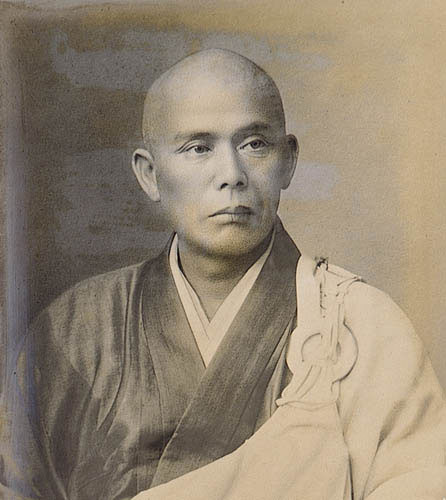
The Venerable Shaku Soen
Unlike other Asian participants, Shaku Sōen did not speak English at the Parliament. His speeches were read by President Barrows from translations that had been prepared in Japan by Shaku Sōen’s disciple D. T. Suzuki. But they still gave a clear expression of two distinctive Buddhist contributions to the Parliament: the idea that Buddhism was consistent with a scientific view of causality—an idea that can be traced to Col. Olcott’s view of a “scientific” Buddhism—and the insistence that Buddhism did not rely on a personal God. This view was in striking contrast to the understanding of God that motivated the Parliament’s organizers.
The Law of Cause and Effect as Taught by the Buddha
In the first of his two speeches, the Zen master Shaku Sōen took up the question, “Why do things change?” His answer was found in the Buddha’s teaching about cause and effect. He explained the five concepts that comprise Buddha’s law. He asserted that there is no effect that can arise without several causes having preceded it, and each one of those causes is in and of itself the effect of causes that preceded it.
In essence, Sōen informed the audience that this continuous relationship of cause and effect leads to the conclusion that the universe had no real beginning. Everything is part of a constant causal loop with no discernable start or end.
Next, he developed his remarks about cause and effect into the principle that he calls “the three worlds”: past, present and future. He said that, while almost all religions consider how one’s conduct in the present life impacts the future, Buddhism takes this causal inference a step further and says that one’s past life inevitably affects the present. If someone is suffering in his or her present life, it is because of bad actions in the past, and if someone is living a happy life in the present it is because of good actions in the past.
Another principle is familiar to everyone who has studied Buddhism even in a cursory way. It is the idea that both happiness and suffering are born out of our own actions, rather than by the intervention of an omnipotent deity. Sōen said that Buddhism refers to this as “self-deed and self-gain” and explains the concept quite succinctly when he says, “Heaven and hell are self-made. God did not provide you with a hell, but you yourself.”1
Finally, he introduces the last principle, which is perhaps the most fundamental of them all. Sōen states that this law is not the cause of an external power, but rather of nature, implying that this is simply how the world works. He does not claim an interventionist god is responsible for happiness or misery, but stresses that humans are the sources of these feelings and conditions, which are products of our past and present actions. Because of this, he emphasizes, “Be kind, be just, be humane, be honest” and people will lead happier lives. The causal law, he asserts, is “the source of moral authority.”
If we open our eyes and look at the universe, we observe the sun and the moon, and the stars in the sky; mountains, rivers, plants, animals, fishes, and birds on the earth. Cold and warmth come alternately; shine and rain change from time to time without ever reaching an end. Again let us close our eyes and calmly reflect upon ourselves. From morning to evening, we are agitated by feelings of pleasure and pain, love and hate; sometimes full of ambition and desire, sometimes called to the utmost excitement of reason and will. Thus the action of the mind is like an endless issue of a spring of water. As the phenomena of the external world are various and marvelous, so is the internal attitude of the human mind. Shall we ask for the explanation of these marvelous phenomena? Why is the universe in constant flux? Why do things change? Why is the mind subjected to constant agitation? For these Buddhism offers only one explanation, the law of cause and effect.
— Excerpt from Shaku Soyen’s 1893 speech, “The Law of Cause and Effect as Taught by the Buddha”
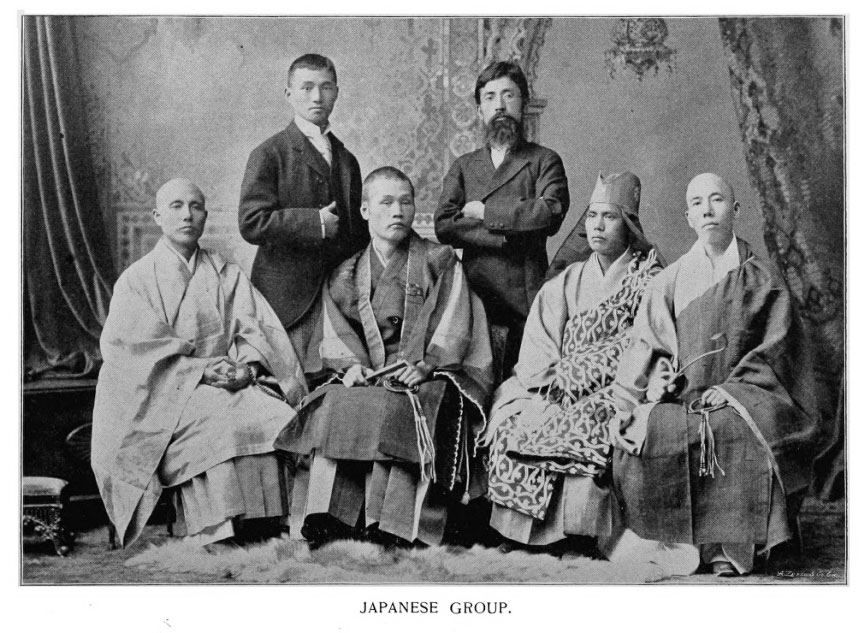
The “Japanese Group,” consisting of four scholarly Buddhist priests (Toki Hōryū, Yatsubuchi Banryū, Shaku Soyen, and Ashitsu Jitsuzen) and two politically active Buddhist laymen (Hirai Kinzō and Noguchi Zenshirō)]. (Source: Walter R. Houghton, ed., Neely’s History of the Parliament of Religions and Religious Congresses at the World’s Columbian Exposition, Compiled from Original Manuscripts and Stenographic Reports (Chicago: F.T. Neely, 1893)
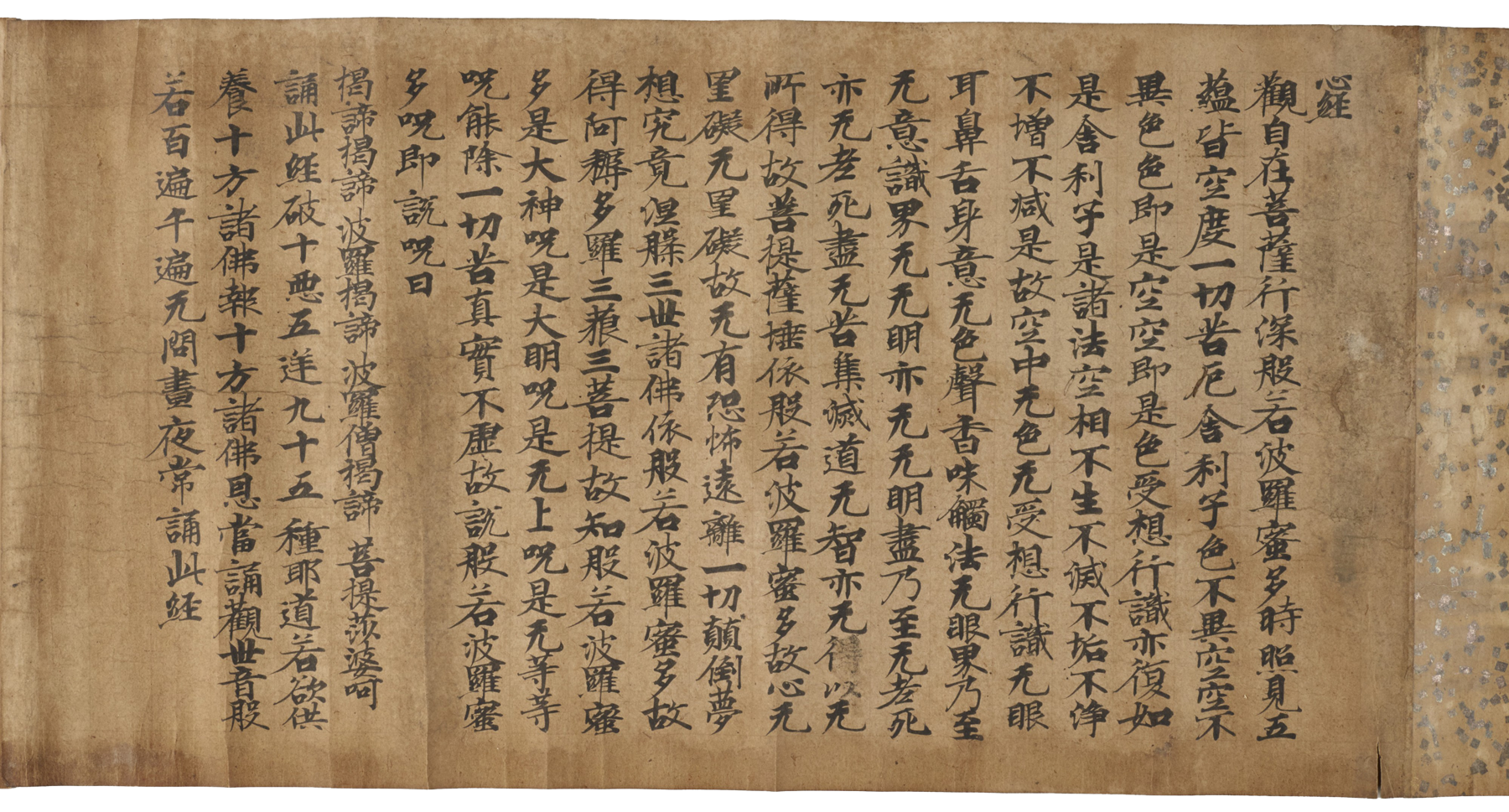
Sumidera Heart Sutra (Sumidera shingyō 隅寺心経), 8th c. Nara period, 710–794. Anonymous Handscroll, ink on paper. (Source: Princeton Art Museum, Museum purchase, Fowler McCormick, Class of 1921, Fund)
Arbitration Instead of War
Shaku Sōen took on a more contentious topic in his second address to the Parliament. Instead of talking about the basic principles of Buddhism, he made a plea to this assembled international audience to apply the principles of tolerance and brotherhood in the field of international law. He anticipated that some Western audiences might question his authority simply because he is Japanese:
“I am a Buddhist, but please do not be so narrow-minded as to refuse my opinion on account of its expression on the tongue of one who belongs to a different nation, different creed and different civilization.”
But he appeals to a higher principle—the “religion of truth”—that will encourage arbitration between opposing nations instead of war.
In the longer version of his speech found in Neely’s History of the Parliament of Religions (edited by Walter R. Houghton, Chicago, 1893), he made a series of very pointed comments about what he called “the present state of the European powers” in which each nation is busily engaged in defending itself against the other at the highest expense in its power.”2 He ended by appealing again to his audience’s sense of fairness: “You must not say ‘go away’ because we are not Christians. You must not say ‘go away’ because we are yellow people. All beings in the universe are in the bosom of truth. We are all sisters and brothers; we are sons and daughters of truth; and let us understand one another much better and be true sons and daughters of truth.”3
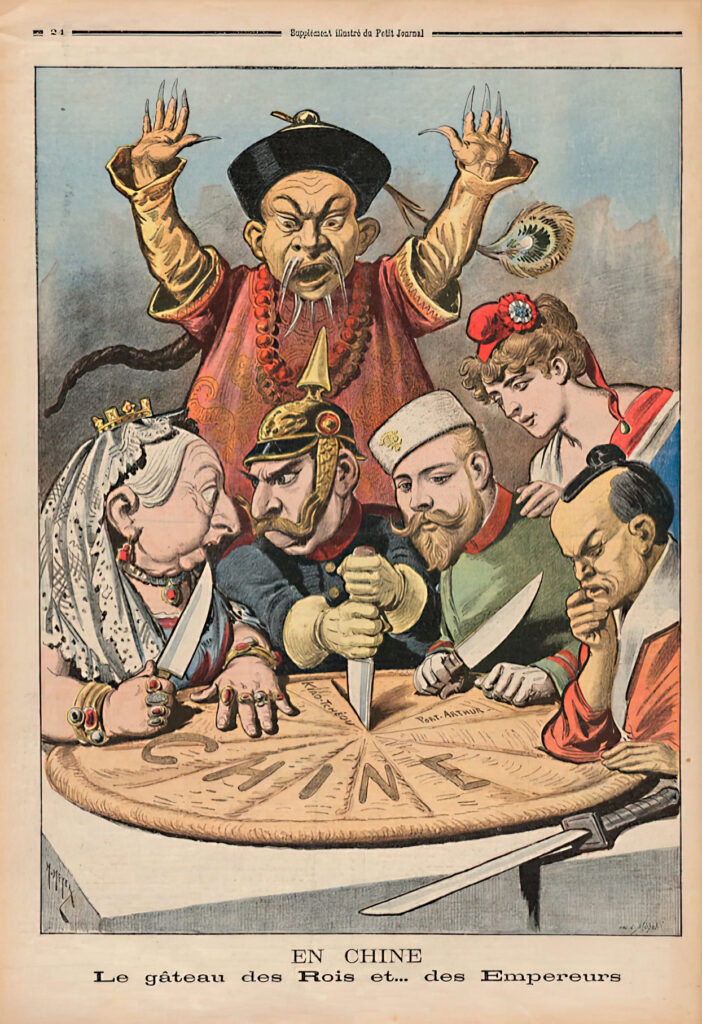
Shaku Sōen’s words are a reminder that political concerns lurked behind even some of the Parliament’s most benign discussion of brotherhood and peace. Even though he did not mention it explicitly, Shaku Sōen shared his fellow delegate Kinza Riuge Hirai’s concern about the injustice of the treaty that had been imposed on Japan in 1858 by America and the European powers in the Treaty of Edo (Tokyo). When Hirai first proposed to raise the issue of the treaty in his speech on “The Real Position of Japan Toward Christianity,” on the third day of the Parliament, John Barrows had attempted to stop him, but Hirai and the Japanese delegation persisted.4 At a time when the Asian delegates were acutely aware of discrimination and unequal treatment by Western powers, the message of tolerance, understanding, and brotherhood often had a strong political dimension.
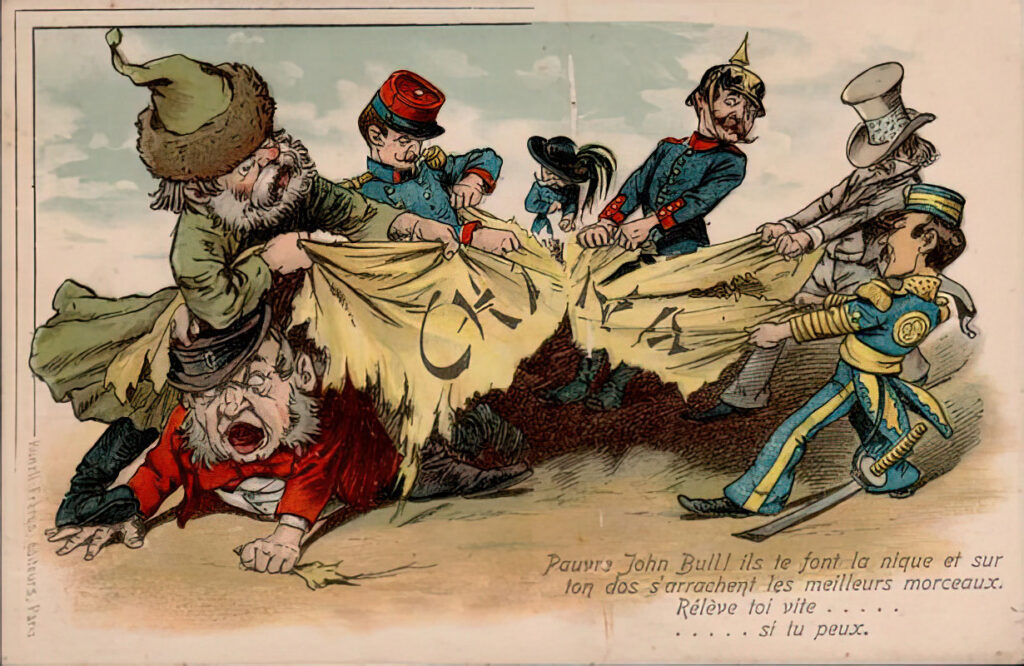
Western powers fighting over China’s resources and markets, from a post card dating from the time of the Boxer Rebellion (ca. 1900). The text reads, “Pauvre John Bull! ils te font la nique et sur ton dos s’arrachent les meilleurs morceaux. Releve toi vite … si tu peux.” (Translation: Poor John Bull! They are making a mockery of you—and fighting over the choicest morsels right off your back. Get back on your feet quickly… if you can.)
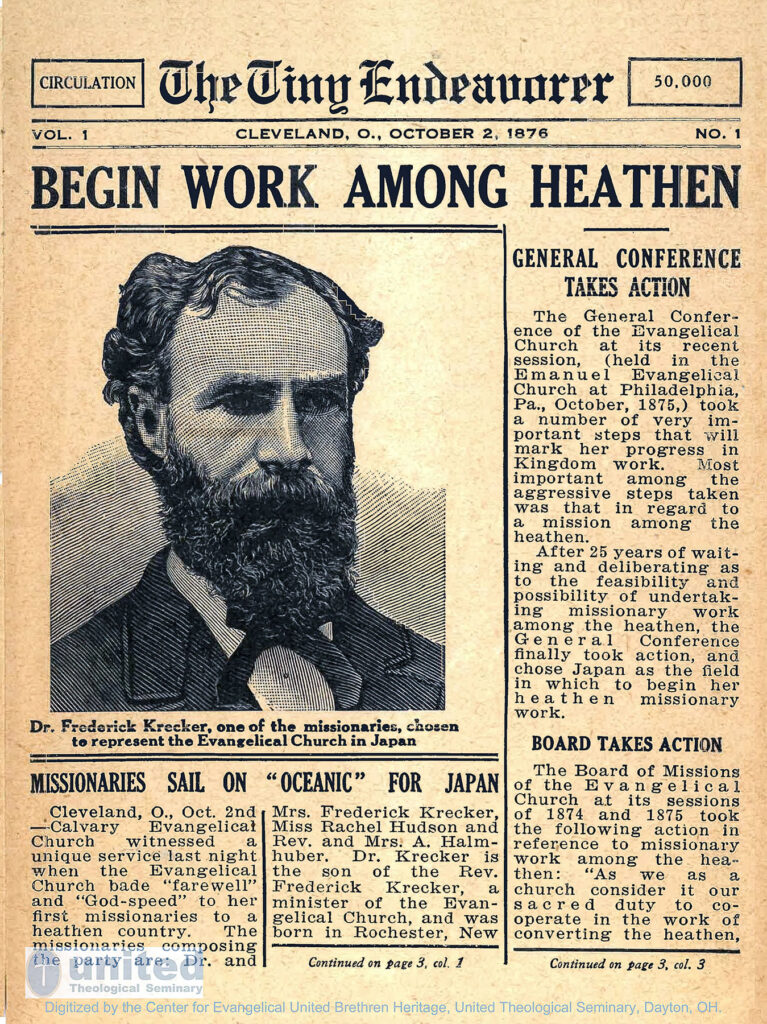
“Begin work among heathen.” The Tiny Endeavorer (Cleveland, OH), Oct. 2, 1876. (Source: United Theological Seminary, Dayton, OH)
We have no judicial power over foreigners in Japan, and as the natural consequence, we are receiving injuries, legal and moral, the accounts of which are seen constantly in our native newspapers…
One of the excuses offered by foreign nations is that our country is not yet civilized. Is it the principle of civilized law that the rights and profits of the so-called uncivilized, or the weaker, should be sacrificed? As I understand it, the spirit and necessity of law is to protect the rights and profits of the weaker against the aggressions of the stronger, but I have never learned in my shallow study of law that the weaker should be sacrificed for the stronger.
Another kind of apology comes from a religious source, and the claim is made that the Japanese are idolaters and heathen. Whether our people are idolaters or not you will know at once if you investigate our religious view without prejudice from the authentic Japanese source. But admitting for the sake of argument that we are idolaters and heathen, is it Christian morality to trample upon the rights and advantages of a non-Christian nation, coloring all their natural happiness with the dark stain of injustice?
If such be the Christian ethics–well, we are perfectly satisfied to be heathen.
Excerpt from Hirai’s speech at the Parliament, “The Real Position of Japan Toward Christianity” (from John Henry Barrows, The World’s Parliament of Religions [Chicago, 1893], pp. 447-449).
Footnotes
- J. W. Hanson (ed.), The World’s Congress of Religions: The Addresses and Papers delivered Before the Parliament, vol. 2 (Philadelphia: W.W. Houston & Co., 1894), p. 390. ↩︎
- W.R. Houghton, Neely’s History of the Parliament of Religions and Religious Congresses at the World’s Columbian Exposition (Chicago: Neely, 1893), 35., p. 1286. ↩︎
- W.R. Houghton, Neely’s History of the Parliament of Religions and Religious Congresses at the World’s Columbian Exposition (Chicago: Neely, 1893), p. 1286. ↩︎
For additional discussion of this controversy, see Judith Snodgrass, Presenting Japanese Buddhism to the West: Orientalism, Occidentalism, and the Columbian Exposition, (Chapel Hill: University of North Carolina Press, 2003), p.68. ↩︎