Room No. 2
At the Fair
The Japanese Pavilion at the 1893 World’s Columbian Exposition in Chicago
World’s Columbian Exposition, Hō-ō-den. c. 1891-1893.
(Source: The Art Institute of Chicago)
World’s Columbian Exposition
The World’s Columbian Exposition was held in Chicago in 1893 to celebrate the 400th anniversary of the discovery of America by Christopher Columbus. As an international exposition, it was a showcase event for the host nation’s progress and civilization as well as an opportunity for foreign countries to illustrate their own achievements in the industries, sciences, and arts.
The exposition had a profound impact on architecture. The buildings created for the event not only functioned as the most explicit physical and visual realizations of the presenters’ self-images, but also opened a window to the world for the 27 million visitors to the fair to learn about participating U.S. states and foreign countries.
The exposition featured approximately 200 buildings in total. While most of the buildings were designed in the European Neoclassical style, white in color and magnificent in scale, 18 foreign sites and buildings assumed distinctive vernacular styles.
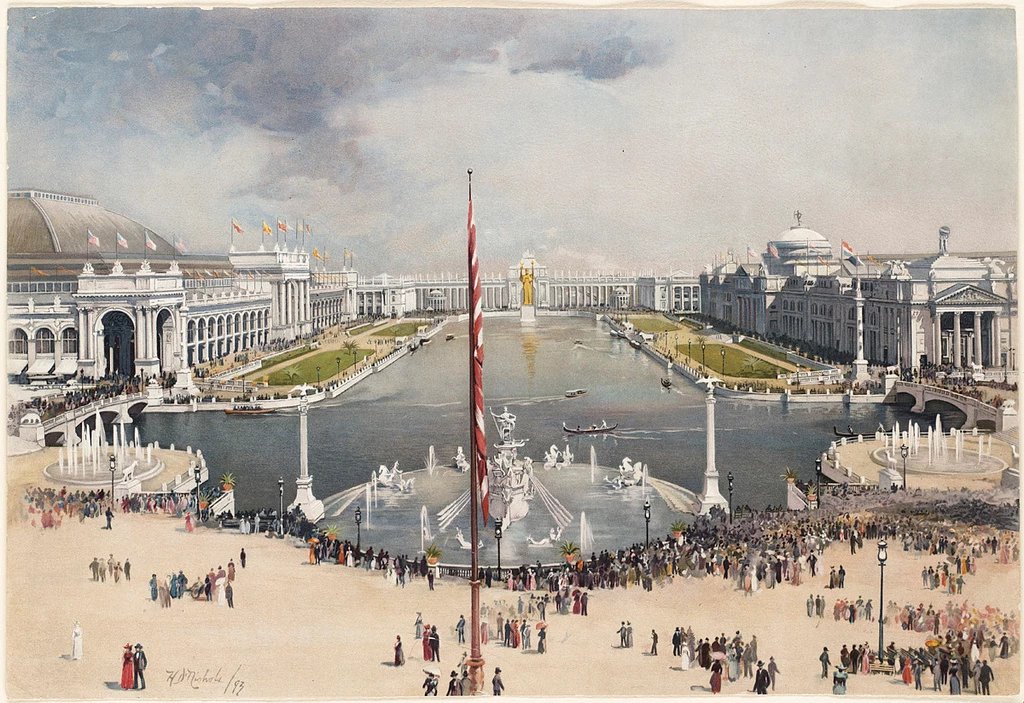
1. Chicago World’s Fair, 1893. (Source: Boston Public Library)
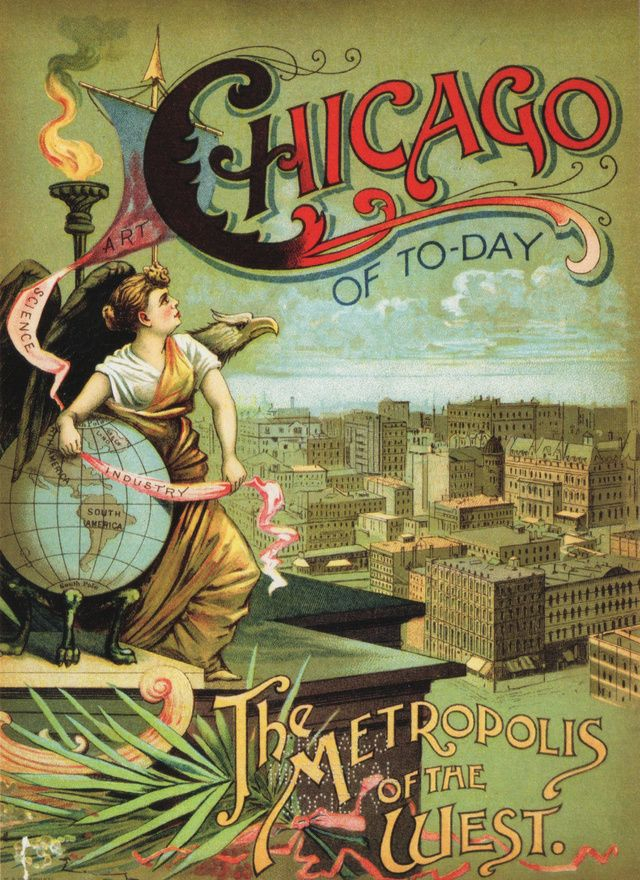
2. Chicago of To-Day. The Metropolis of the West. The nation’s choice for the World’s Columbian Exposition, 1893 (Source: Internet Archive)
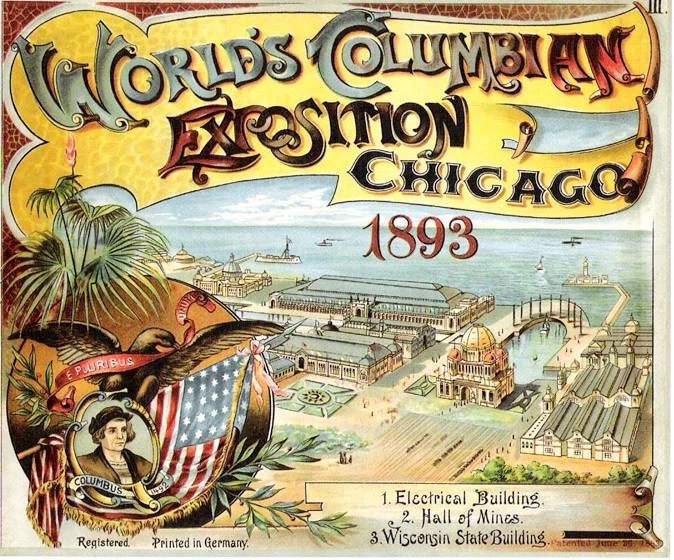
3. Advertisement for the World’s Columbian Exposition (also known as the Chicago World’s Fair), 1893. (Source: Wikimedia Commons)
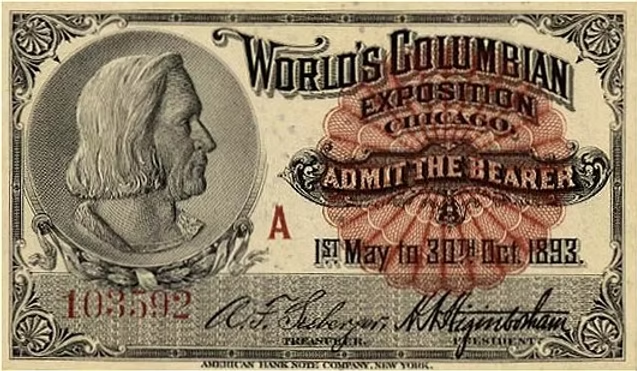
4. Admission Ticket to the fair, with a portrait of Christopher Columbus, 1893. (Source: University of Maryland Libraries)
Explore
The World’s Columbian Exposition Buildings
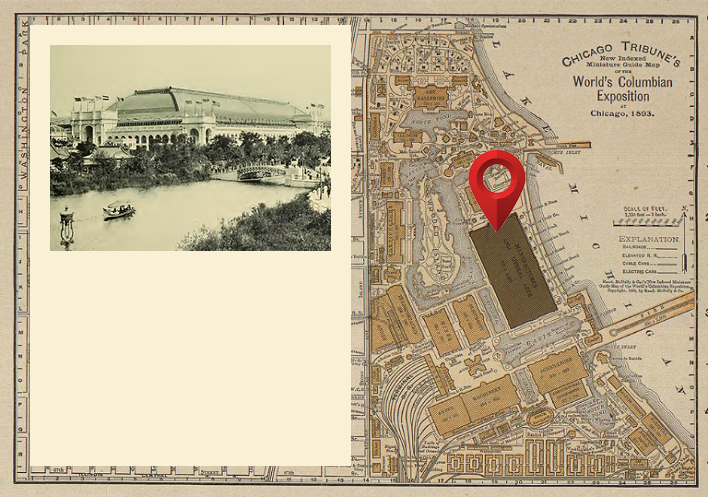

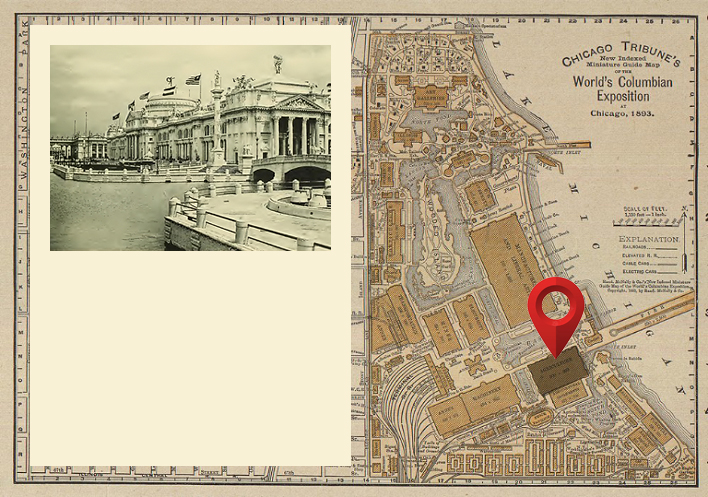
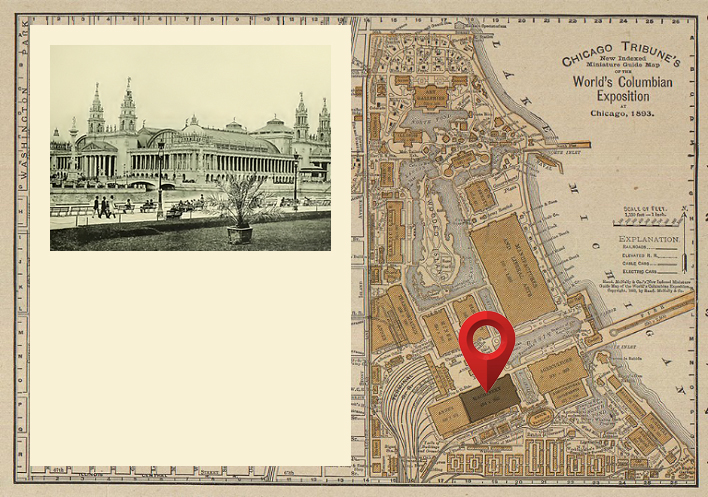
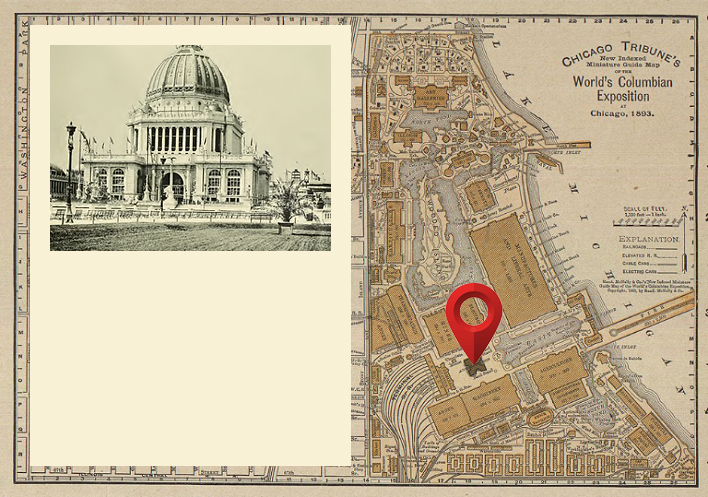
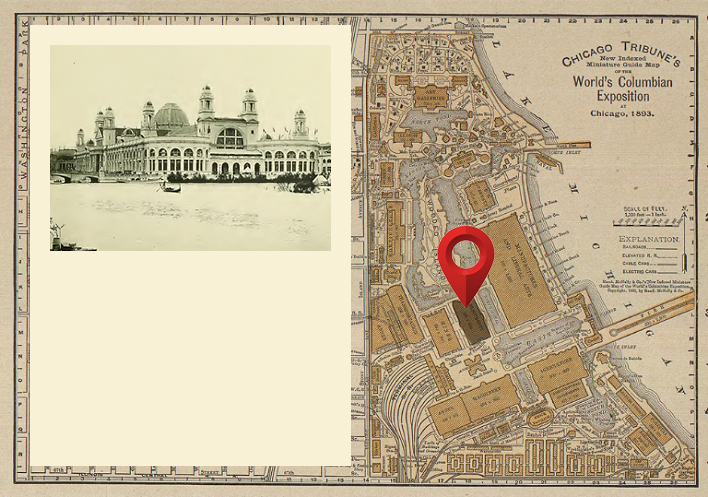
Navigating the World’s Columbian Exposition
This map published by the Chicago Tribune shows the layout of the World’s Columbian Exposition. The main exposition ground was located in Jackson Park, on the shore of Lake Michigan. In addition to the main section, many of the minor buildings and special exhibits were located on the strip of space known as Midway Plaisance that connected Jackson Park and Washington Park.
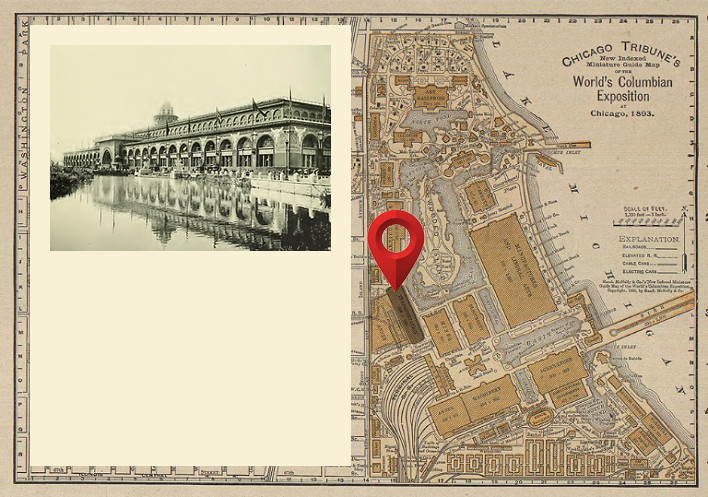
Some of the main buildings in the fairground included: the Administration Building, the Agricultural Building, the Manufactures and Liberal Arts Building, the Mines and Mining Building, the Electricity Building, the Machinery Hall, the Woman’s Building, the Transportation Building, the Fisheries Building, the Forestry Building, the Horticultural Building and the Anthropology Building.
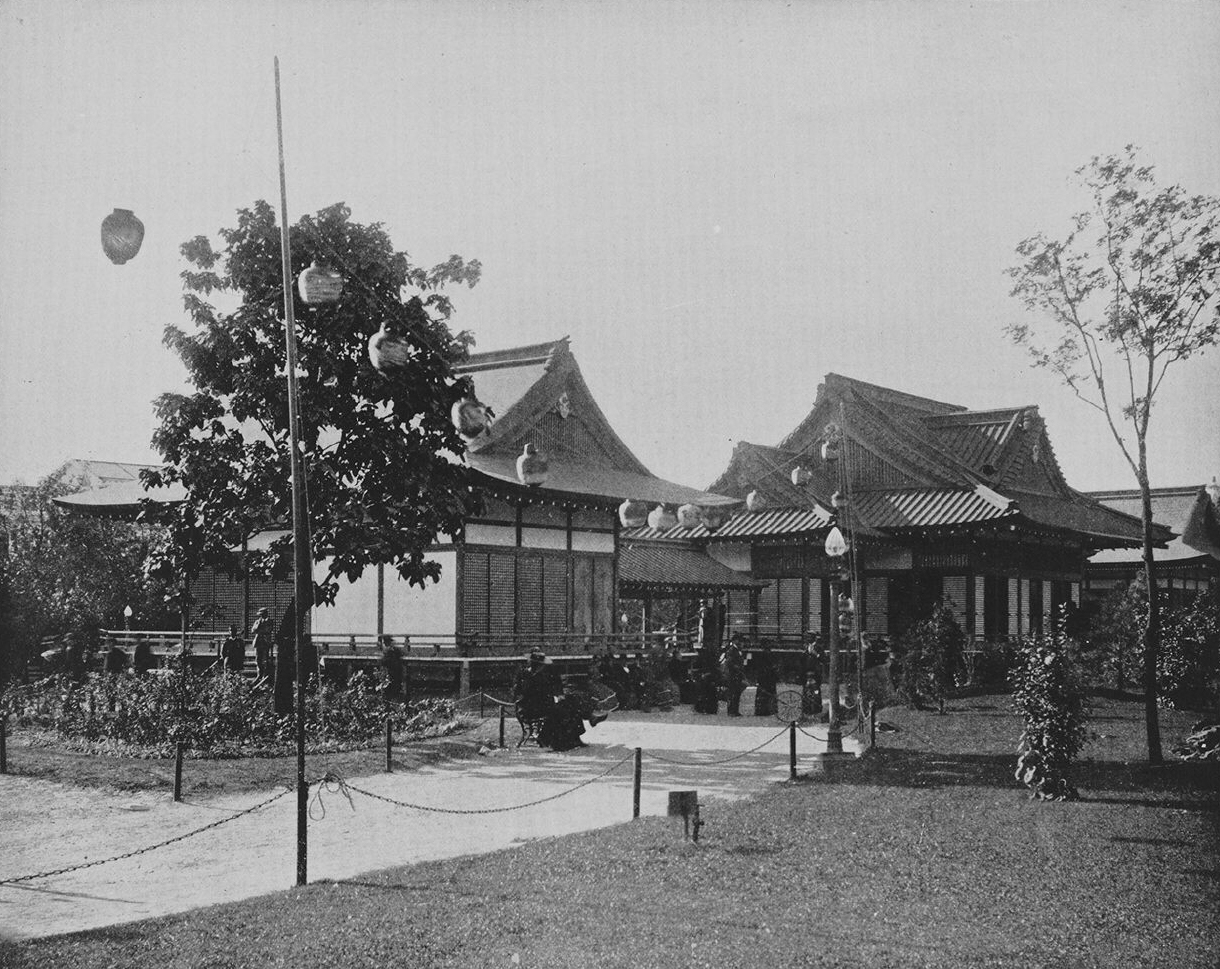
Japan at the Fair
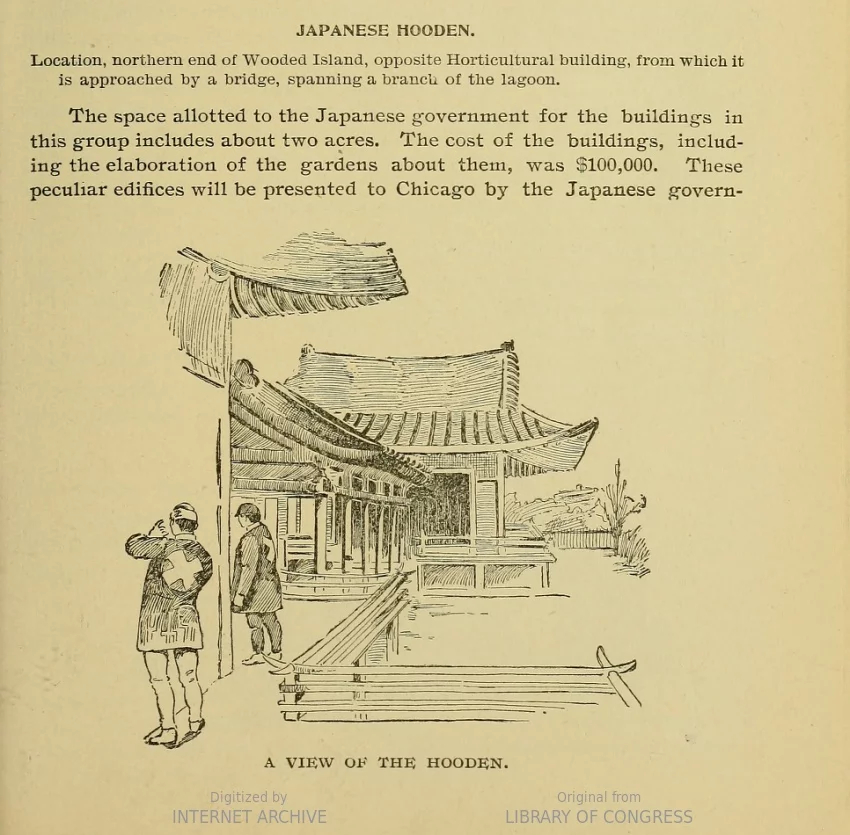
The Japanese Hō-ō-den.
(Source: Illinois Institute of Technology)
Japan at the World’s Columbian Exposition
Japan was one of the first foreign countries to show great interest in participating in the Chicago exposition and led all foreign countries in the amount of the appropriation, providing around $630,000 for its display.
At the fair, Japan contributed to all of the main exhibition themes except machinery and electricity. In the Manufactures Building, Japan presented samples of silk textile, embroidery, porcelain, pottery and many other goods for which it was famous. In the Agriculture Building, Japan’s tea industry was a highlight. In the Fine Arts Palace, Japan displayed contemporary paintings, porcelains, textile fabrics, carvings in ivory and wood, lacquered wares, and enameling on metal.
Besides its exhibits in the various main departments, Japan also erected three freestanding structures on the fairgrounds: the Japanese Pavilion (also known as the Hō-ō-den), the Tea House, and the Japanese Bazaar. Among these, the Hō-ō-den drew the most attention; it was built as a permanent structure and later gifted to the City of Chicago at the close of the exposition.
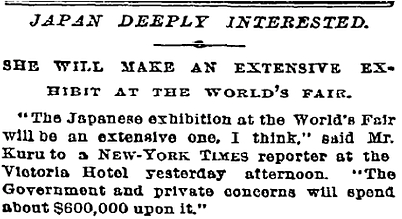
1.
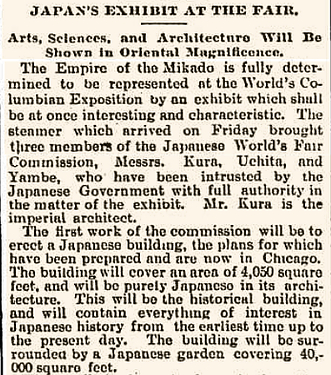
2.
1. “Japan Deeply Interested.” (Source: The New York Times, February 17, 1893).
2. “Japan’s Exhibit at the Fair.” (Source: Chicago Tribune, Sept. 24, 1892).
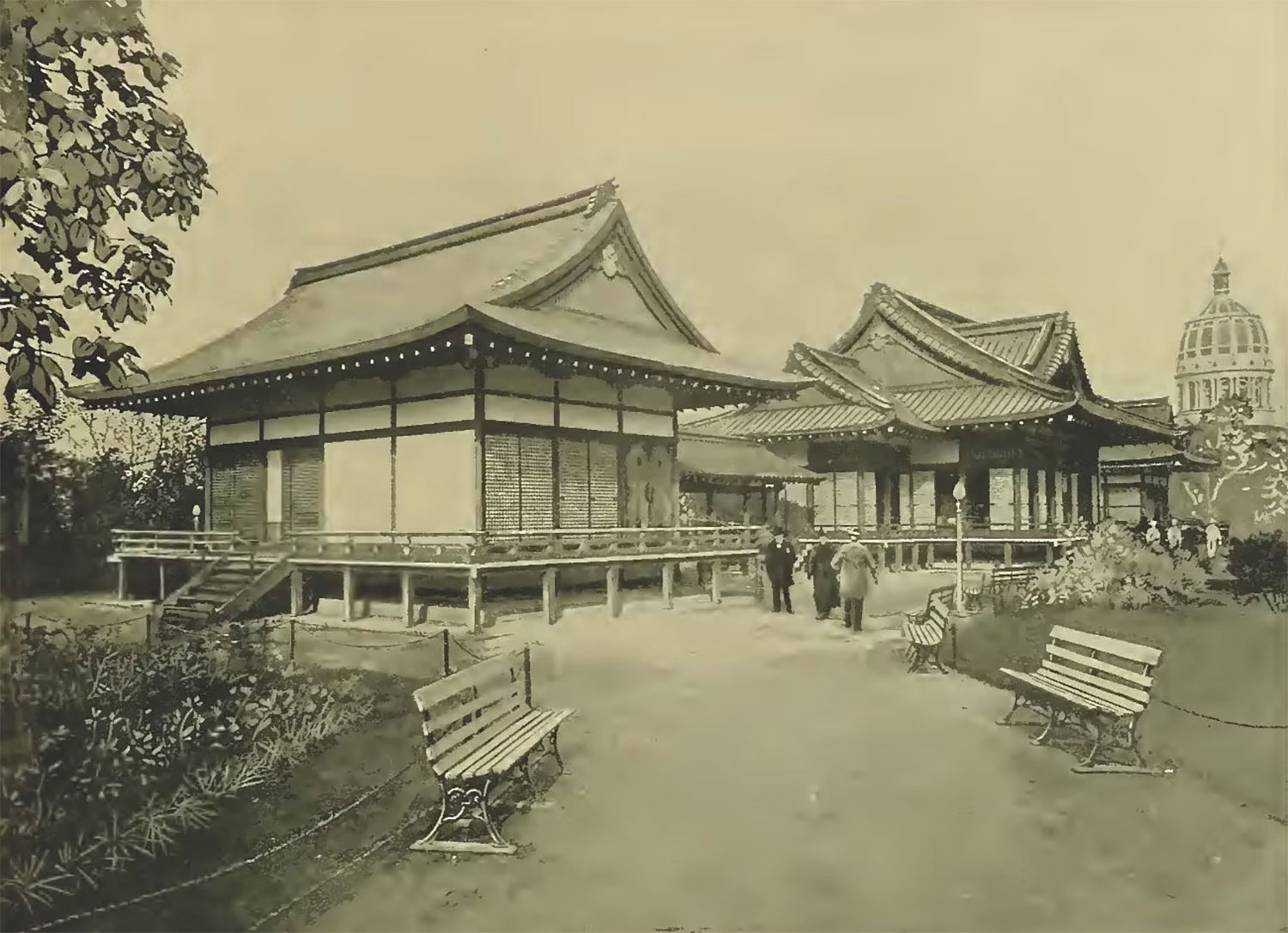
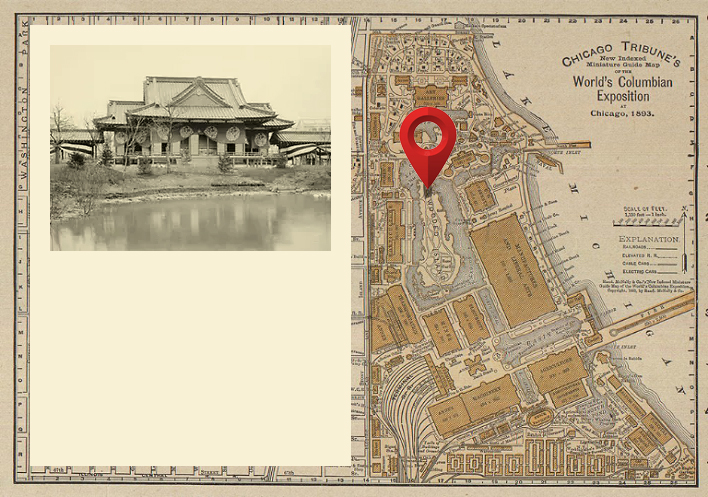
The Japanese Pavilion, Hō-ō-den
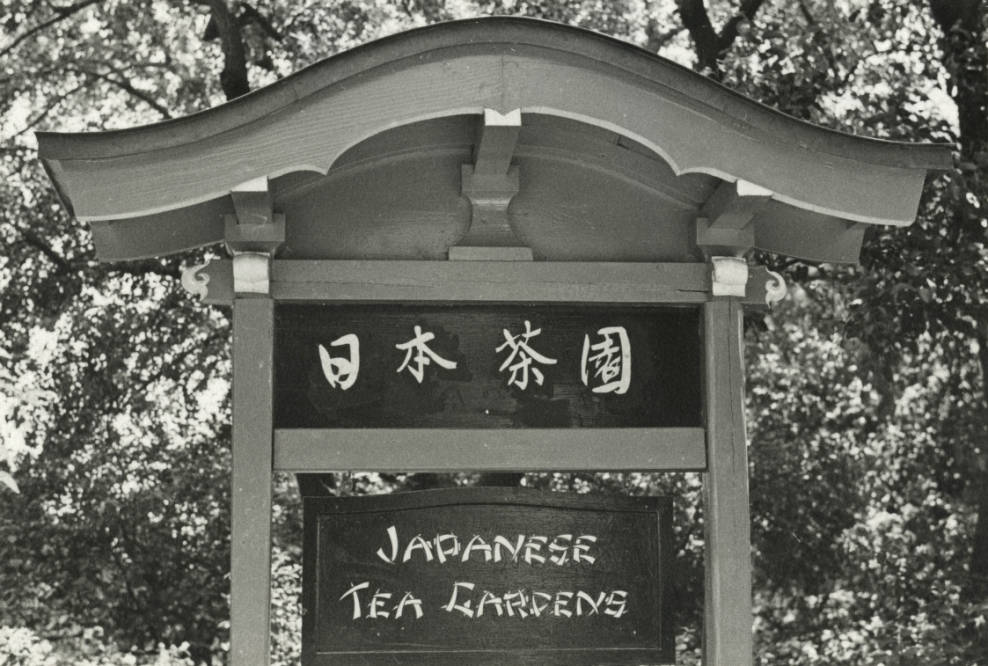
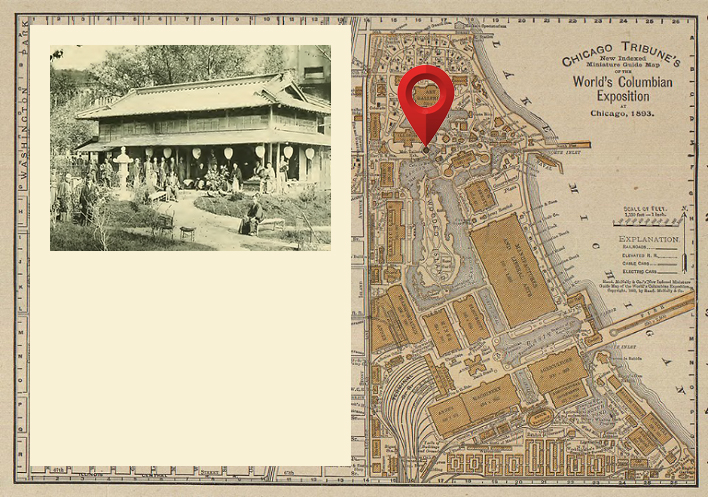
The Japanese Tea House
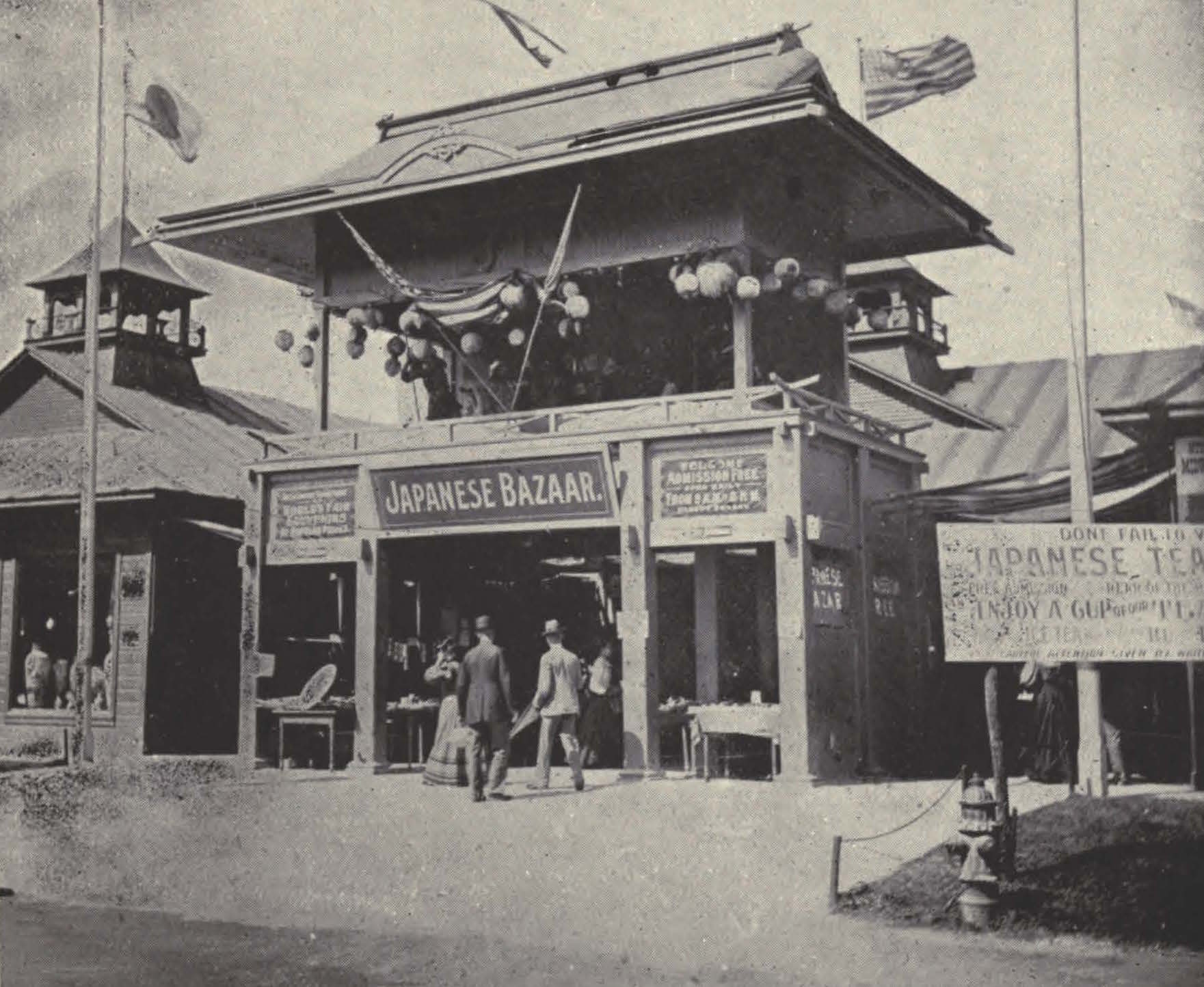
The Japanese Bazaar
The Japanese Pavilion,
Hō-ō-den
“From an architectural standpoint it is perhaps the most interesting contribution to the Exposition. For it is not set up as an imitation, but is what it pretends to be, a genuine product of materials and labor that has never before been seen on this continent.”
— P.B. Wight, “Japanese Architecture at Chicago,”
in The Inland Architect and News Record, December 1892.
The Hō-ō-den, or Phoenix Palace.
(Source: Internet Archive)
Construction of the Hō–ō-den
To construct the Japanese Pavilion, Hō-ō-den, Japanese carpenters traveled across the ocean and arrived in Chicago to demonstrate their specialized craftsmanship. To save time, all of the building materials were already worked and fitted by hundreds of men in Japan months earlier. The materials were then transported to Chicago at great expense, and only twenty-four workmen were needed to perform the actual construction on site.
News reports at the time noted that the chosen carpenters were the most skillful ones, and they talked and chanted songs energetically during the construction. Photographs showed them dressed in special workmen’s half coats (happi) that bore the trade insignia indicating their esteemed status as master carpenters.
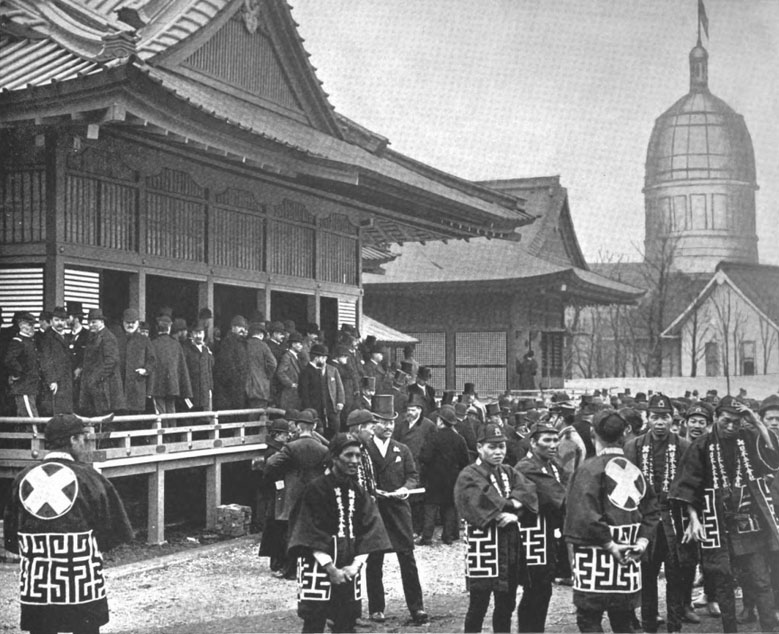
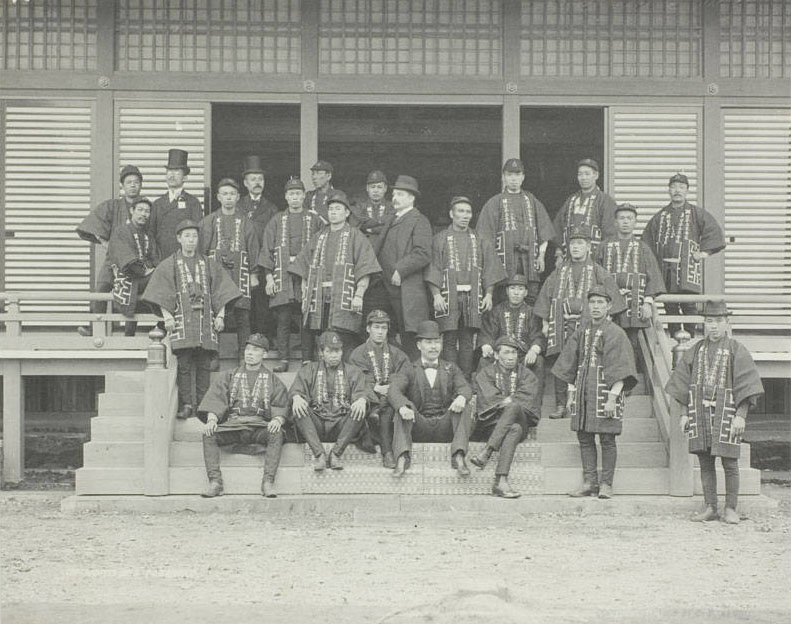


First to last:
1. The Dream City: a Portfolio of Photographic Views of the World’s Columbian Exposition. St. Louis, Mo.: Published weekly by N.D. Thompson Publishing Co., 1893. (Source: Babel Hathitrust)
2. World’s Columbian Exposition, c. 1891-1893. (Source: The Art Institute of Chicago)
3. Constructing Japanese Pavilion Hō-ō-den at World’s Columbian Exposition, Chicago, c. 1893. (Source: Wikimedia Commons)
4. Constructing Japanese Pavilion Hō-ō-den at World’s Columbian Exposition, Chicago, c. 1893. (Source: Wikimedia Commons)
5. Constructing Japanese Pavilion Hō-ō-den at World’s Columbian Exposition, Chicago, c. 1893. (Source: Wikimedia Commons)
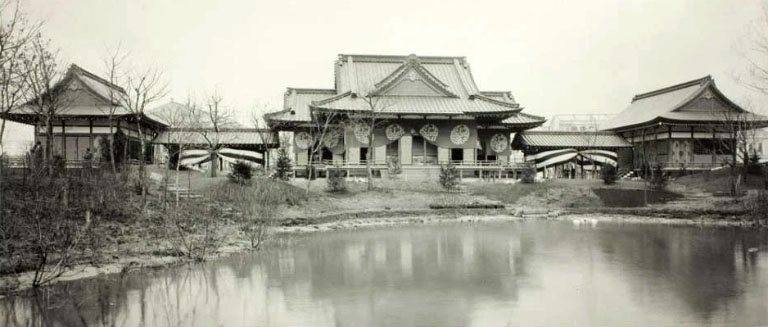
Japanese Hō-ō-den. (Source: The Art Institute of Chicago)
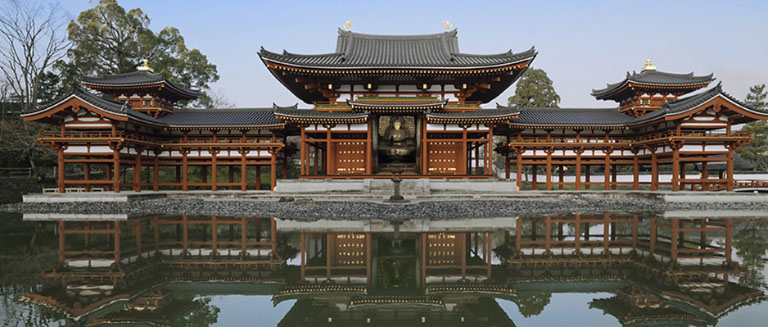
Hō-ō-den is modeled after the Hōōdō of Byōdōin, Uji, Kyoto. (Source: Byodoin.or.jp)
Today, the Hōōdō is the only remaining original building of Byōdōin and was registered by UNESCO as a World Heritage Site in 1994. Learn more through the official website of Byōdōin here.
The Hō–ō-den as a Reproduction of a Historic Model, Byōdōin
The Japanese Pavilion by design resembled the main building of an ancient Japanese Buddhist temple Byōdōin, located outside of Kyoto in the city of Uji.
The aristocrat Fujiwara no Yorimichi created Byōdōin in 1052 by converting a pastoral villa into a Buddhist temple. The Hōōdō (Phoenix Hall) was the most famous building in the Byōdōin complex, as it was extraordinary in architectural form as well as housed a rich concentration of sculptural icons and painted panels. The building comprises a central hall, two side corridors and a rear corridor that approximate the form of a phoenix (hōō) with spreading wings and long tail.
Modeled after the remarkable Hōōdō of Byōdōin, the Chicago replica thus brought an authentic example of Japan’s unique culture and history to a world audience.
Symbol of the Phoenix (Hōō)
“The Ho-o is described by the ancients as having the head of a cock, the beak of a sparrow, a neck like a moving snake, feathers like dragon scales piled one upon another, the wings of a Kirin (a mythical animal), and a tail like that of a fish. Its plumage is brilliant with all the colors, the whole effect being one of supernatural beauty.”
— Okakura Kakuzo, The Hō–ō-den (Phoenix Hall): An Illustrated Description, 1893.
The name of the historical Hōōdō (Phoenix Hall) of Byōdōin in Japan derived from its physical likeness to the mythical phoenix bird; the building also features a pair of bronze phoenixes that adorn its roof ridge. Similarly, the phoenix motif could be found everywhere in the Hō-ō-den at the 1893 World’s Columbian Exposition. The phoenix, an imaginary bird, appeared in earliest Chinese texts and took form in paintings and architectural decoration. After its introduction to Japan, the motif continued serving as an auspicious symbol on elite buildings and artworks.
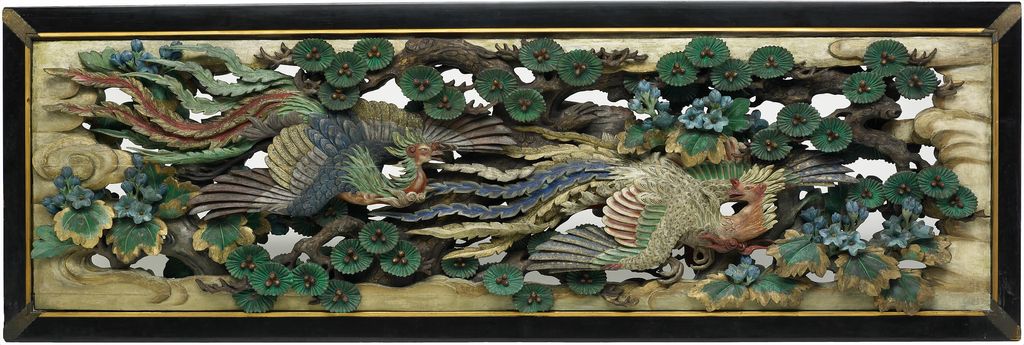
Ho-o (Phoenixes) At Play shows male and female phoenixes cavorting with their offspring. This wall painting was by Professor Hashimoto Gahō and his pupils from the Tokyo School of Fine Arts. (Source: Art Institute Chicago)
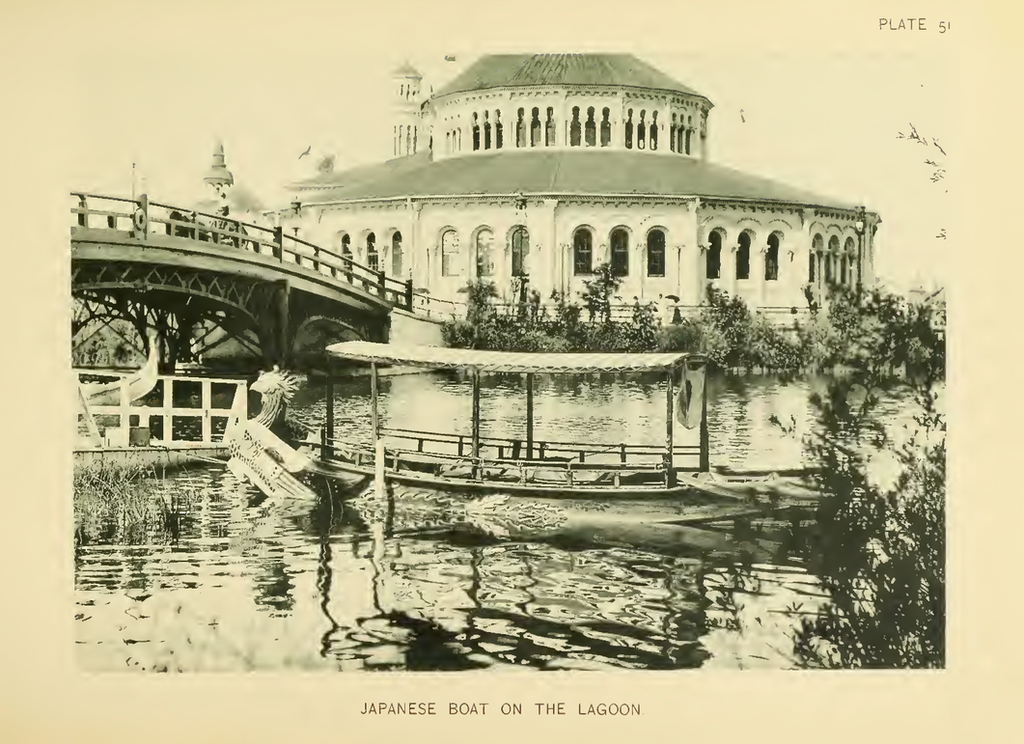
Higinbotham, H. D., and Arnold, C. D. Official Views Of The World’s Columbian Exposition. 2007. (Source: Archive.org)
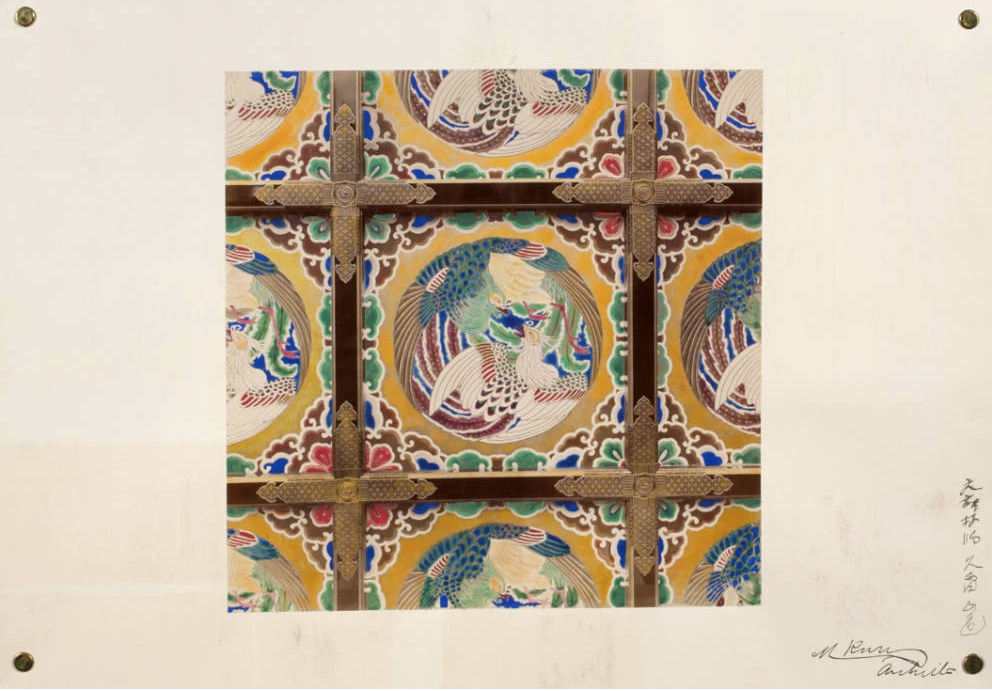
Album of Souvenirs of the World’s Columbian Exposition collected by D.H. Burnham during his services as Director of Works. Unidentified artwork. (Source: The Art Institute of Chicago)
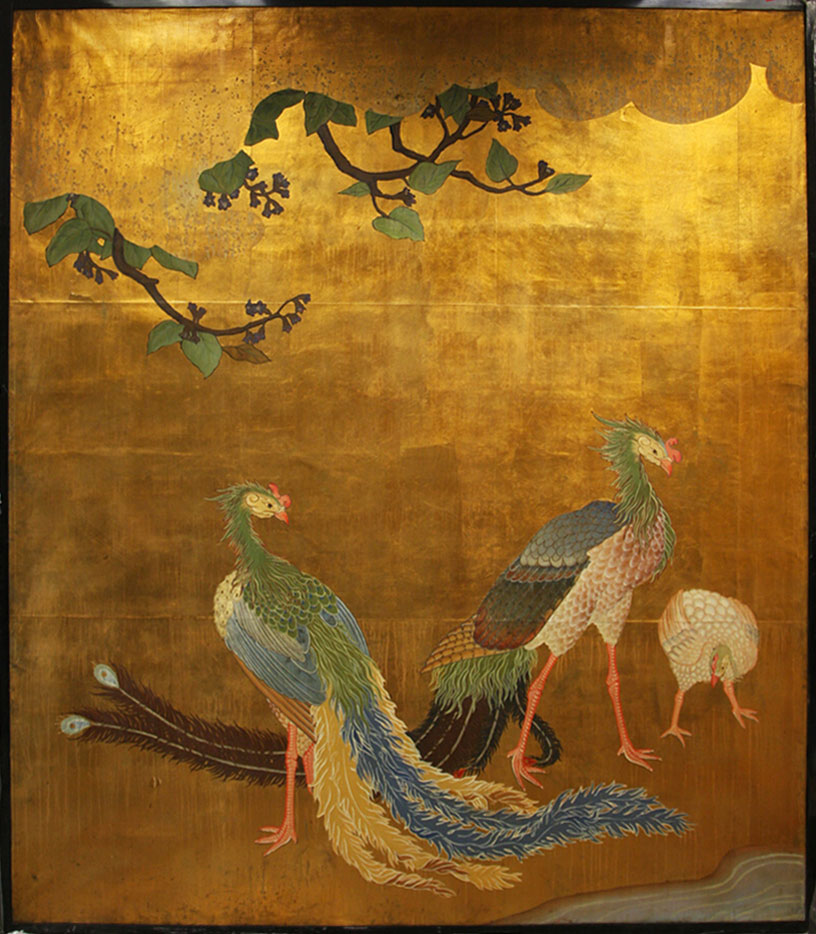
Long thought to be lost along with the fair’s original architecture (the pavilion was restored in 1934 and then destroyed by fire in 1946), three panels of sliding doors (fusuma) painted in gold and colors were rediscovered in 2015 inside a Chicago Park District storage facility. (Source: City of Chicago)
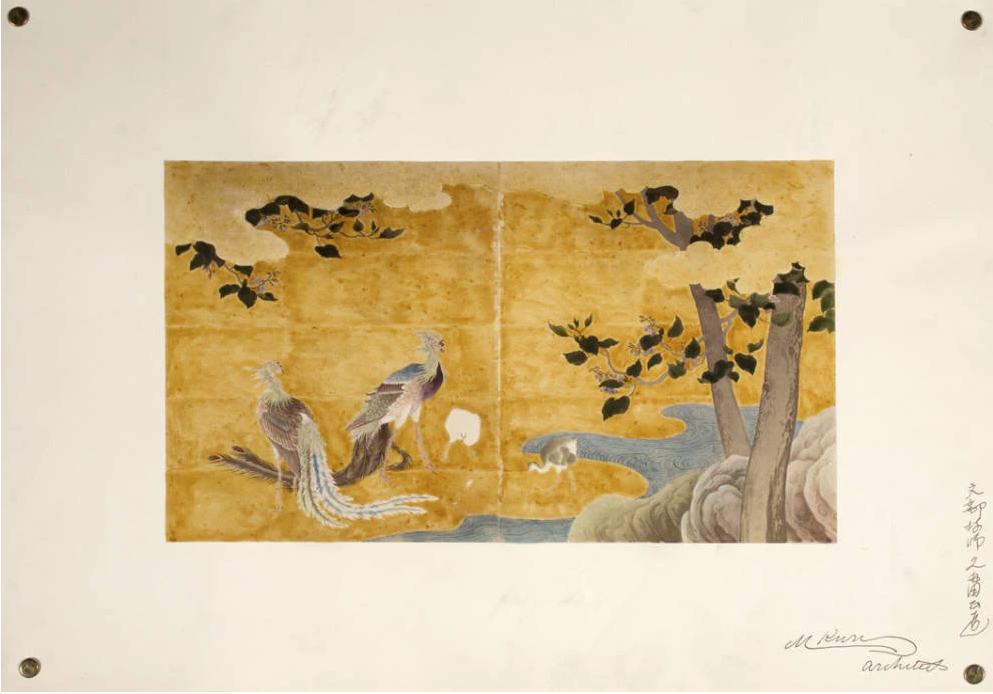
Album of Souvenirs of the World’s Columbian Exposition collected by D.H. Burnham during his services as Director of Works…, Unidentified artwork. (Source: The Art Institute of Chicago)
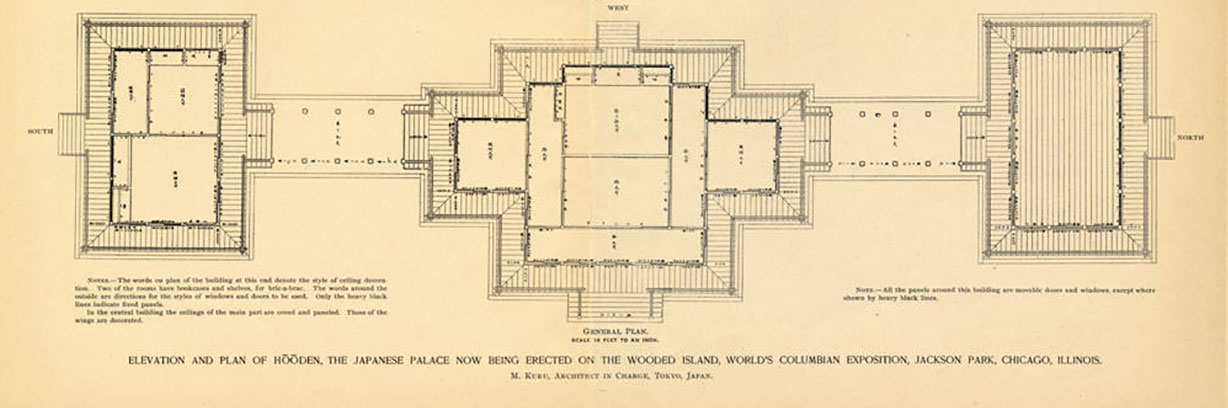
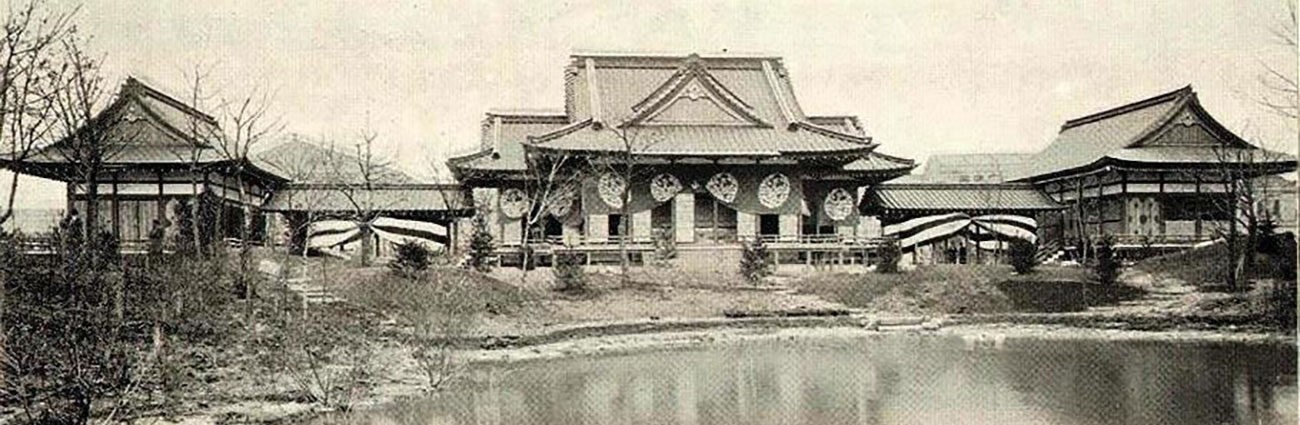
The Japanese Pavilion, Hō–ō-den, at the Chicago fair consisted of a central hall and two smaller flanking halls. In this way, the pavilion’s three halls approximated a body with two outstretched wings, suggesting a flying phoenix. (Source: The Art Institute of Chicago)

A Unique Location: The Hō–ō-den on the Wooded Island
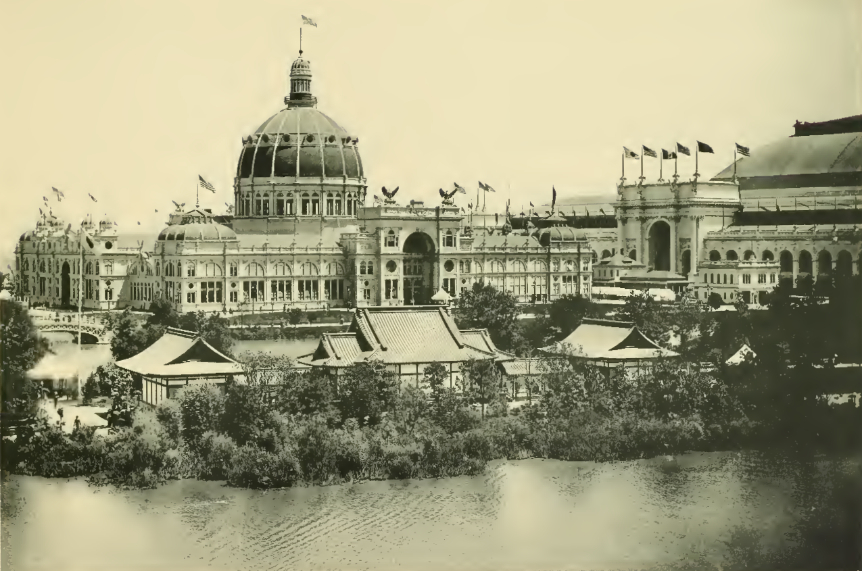
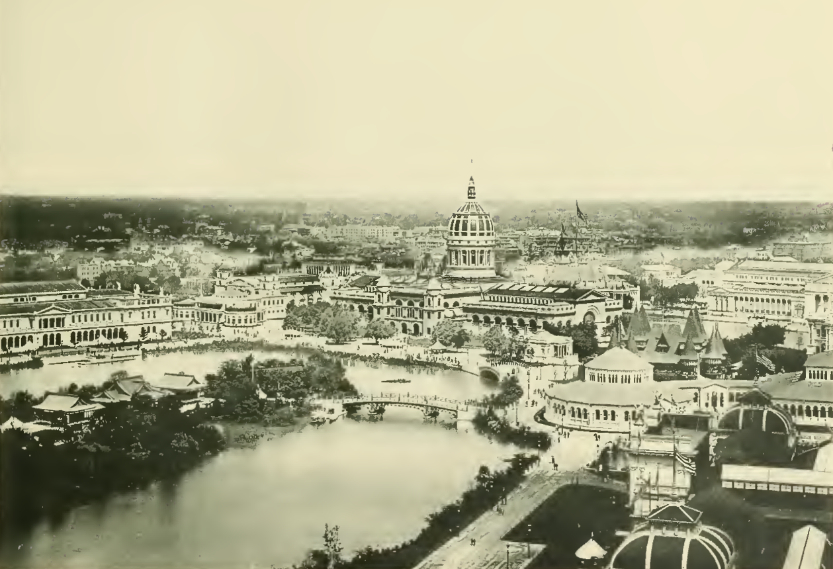
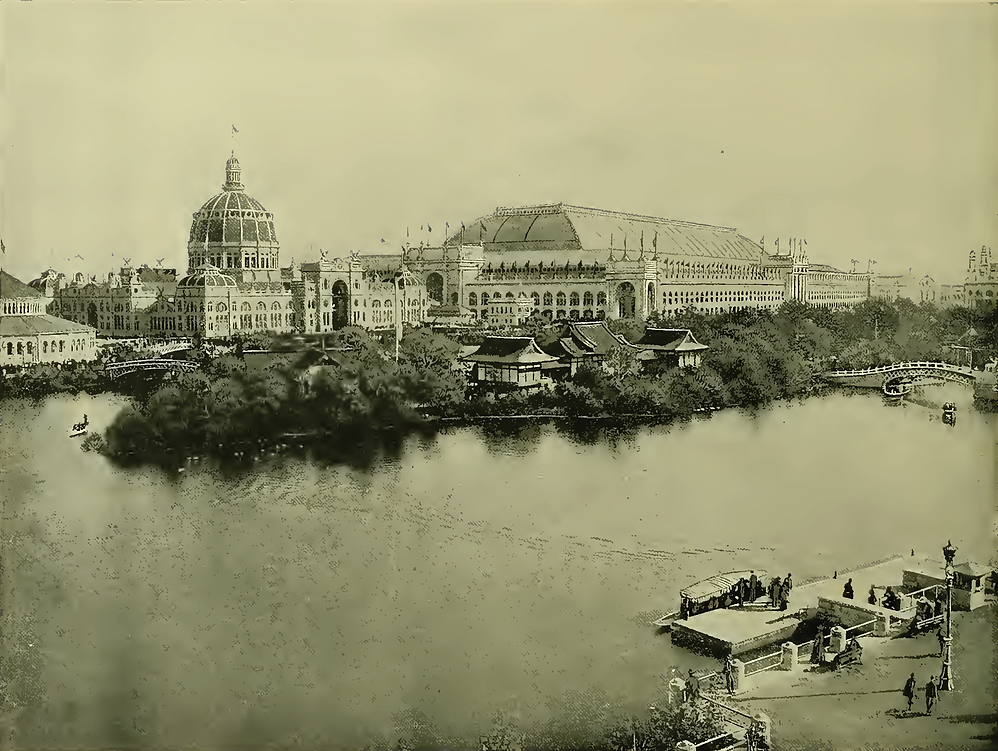
The Japanese Pavilion was given a unique site at the exposition, away from the crowded main section where all the U.S. state buildings and foreign pavilions were located. Similar to its ancient model of Byōdōin, which is surrounded by a lush garden and a peaceful pond, the 1893 Hō-ō-den was placed on the Wooded Island where trees and water abound. In terms of both style and scale, it contrasted sharply with the majestic European Neoclassicism cladding the main buildings. The Japanese Pavilion and its verdant environment expressed a scenic beauty that distinguished itself from the rest of the fair.
The Hō–ō-den as a National Pavilion
While its bird form and natural setting were modeled after the historical Hōōdō of the temple Byōdōin, the Hō-ō-den at the Chicago exposition was not a Buddhist temple but a national pavilion that aimed to embody the magnitude of the Japanese nation to a world audience. Hō-ō-den was thus staged to present a progression of artistic and architectural achievements. The pavilion’s three connected halls represented designs from three major periods in Japanese history.
↑
↑
↑
South Wing
Ashikaga Period
(1350 – 1550)
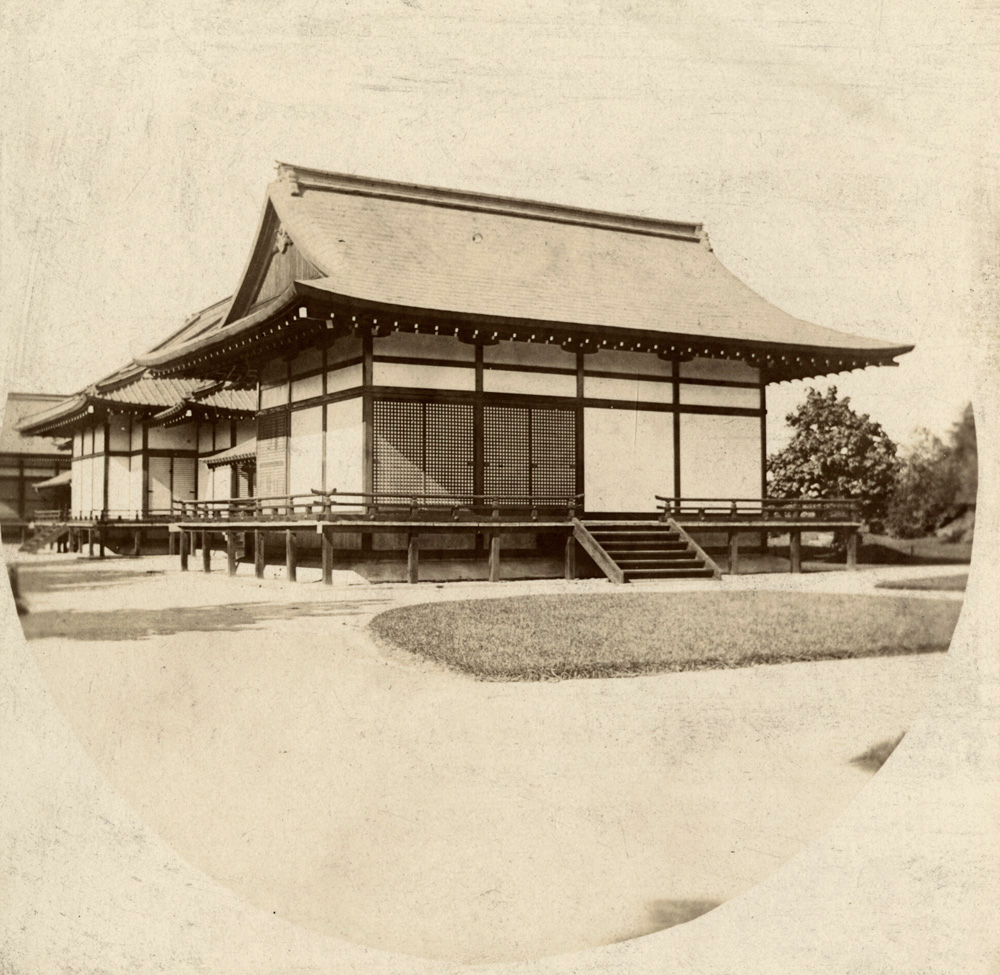

The south wing was constructed in the style of the Ashikaga period (1350-1550), when Zen Buddhism and Chinese philosophy were in vogue in Japan. The building included a tearoom where the tea ceremony could be performed.
Central Hall
Tokugawa Period
(1603 -1868)
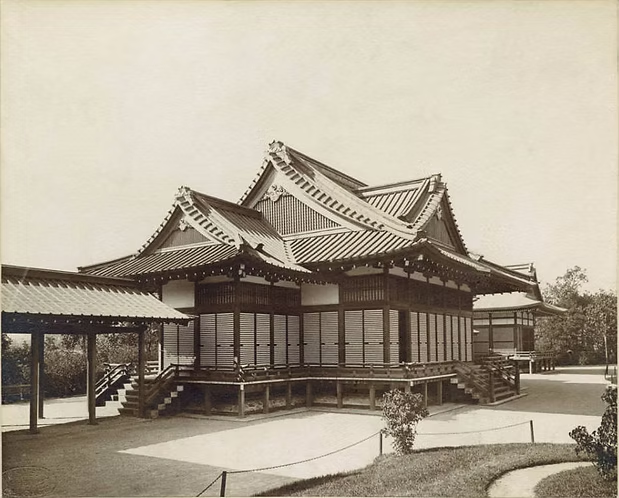
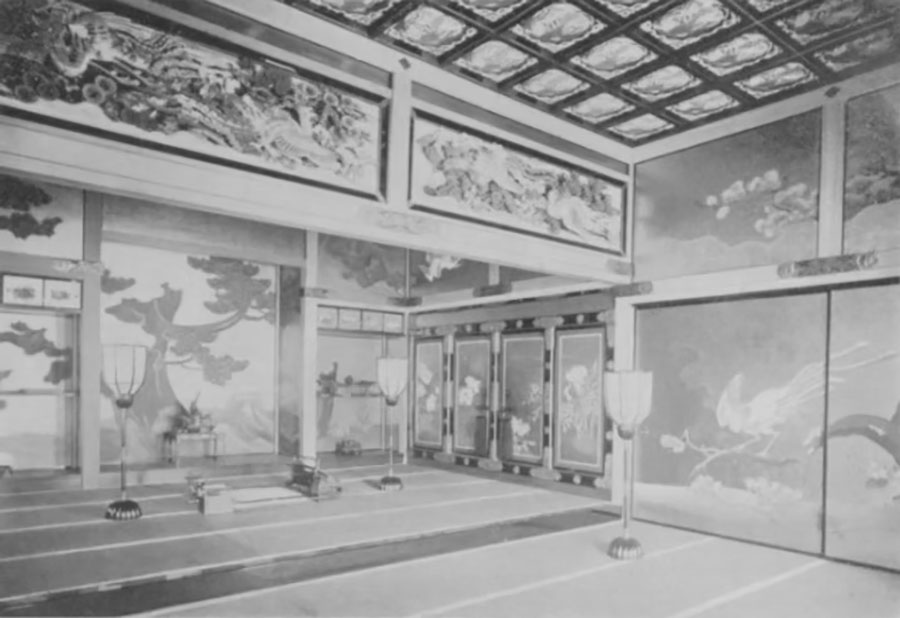
The central hall represented the prevailing style during the Tokugawa period (1603-1868). The rooms in this hall were the most elaborately and richly decorated, with lacquered, gilded, carved and painted works covering almost every possible surface.
North Wing
Fujiwara Period
(880 – 1150)
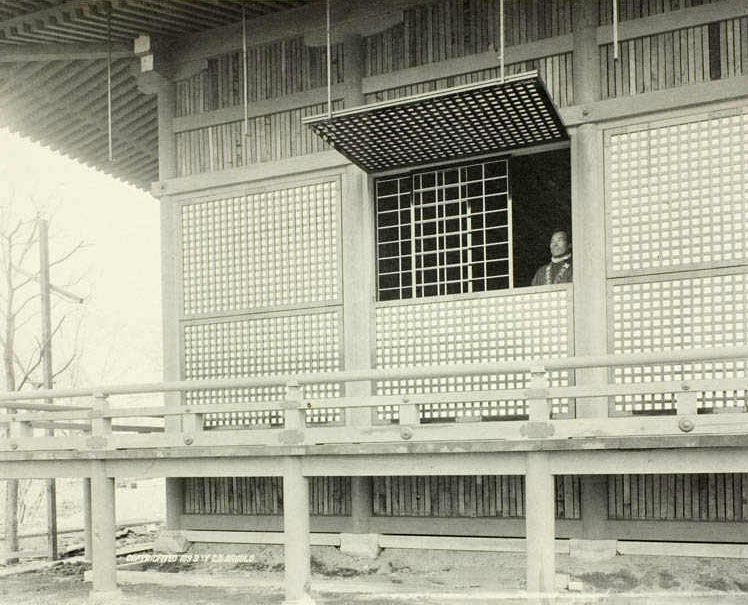
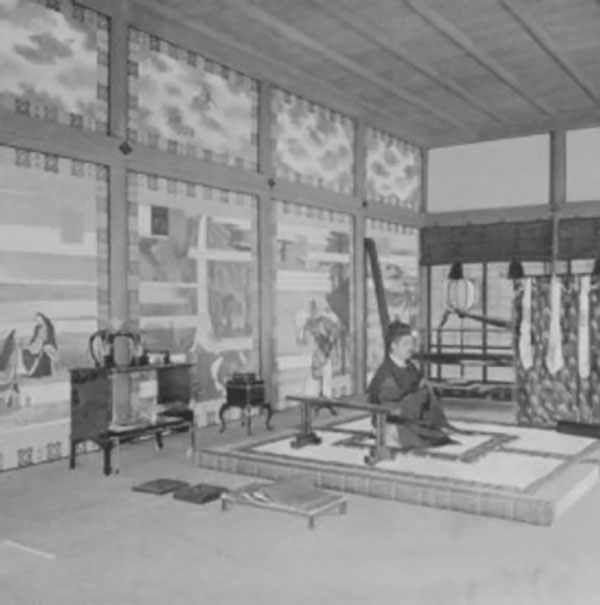
The north wing assumed the style of the Fujiwara period (880-1150), an era of courtly accomplishments. At the time, sliding doors were not yet in use; instead, vertical shutters served as exterior enclosure and were removable for admitting light and air when desired. On the inside, walls were covered with papers an decorated with paintings.
The whole project of the Hō-ō-den was carried out under the Japanese Imperial Commission, and the architectural design was supervised by Kuru Masamichi, a university-trained architect. It is also worth noting that the professors and students of the Tokyo School of Fine Arts designed the decorations inside the Hō-ō-den.
Different Responses to the Hō-ō-den
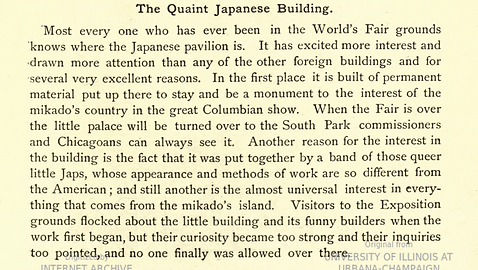
The World’s Fair as Seen in One Hundred Days: containing a complete…, 1893. (Source: Babel Hathitrust)
Praise
According to the guidebooks, daily newspapers and academic periodicals of that time, the Hō-ō-den was a favorite place for many curious visitors and, artistically speaking, a great contribution to the fair and the Western world. The praise is at times double-edged, when the exoticism of the pavilion is considered its main attraction.
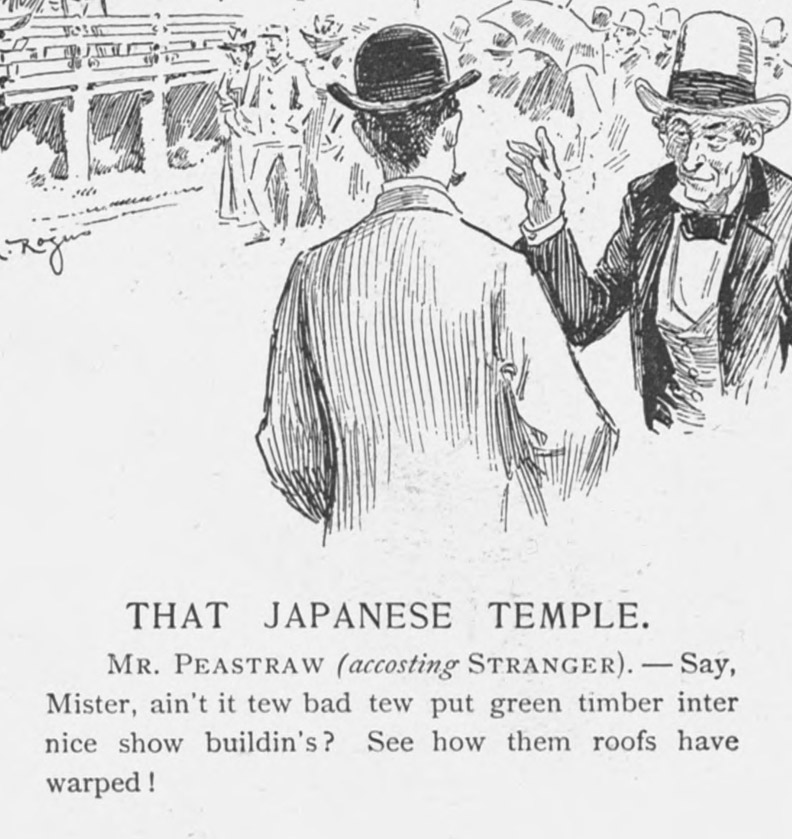
World’s Fair Puck, 1893. (Source: Babel Hathitrust)
Sarcasm
The conversation shows a moment when the visitors are making fun of the Hō-ō-den. Although it is a clip from a comic book in which the characters spoke sarcastically about nearly everything at the fair, the racist undertone of the comment is palpable.
The Best Things to be Seen at the World’s Fair, 1893. (Source: Babel Hathitrust)
Misconception
Despite the availability of tourist albums and English-language guidebooks, Americans still remained largely unfamiliar with Japanese monuments and landmarks. Several publications about the fair called the Hō-ō-den a reproduction of the Golden Pavilion (Kinkaku) in Kyoto. The Golden Pavilion, also a historical Buddhist structure, is three stories in height, with the exterior surface of the top two stories covered in gold foil. The confusion of the Golden Pavilion for the Phoenix Hall, two structures with little physical resemblance, shows the lack of basic information about Japan among Americans at the time.
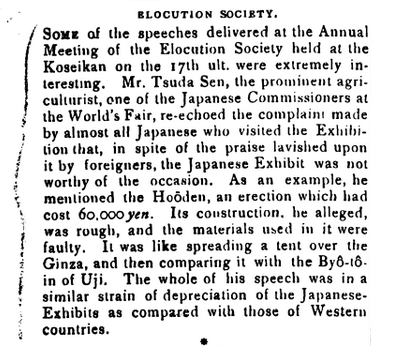
The Japan Weekly Mail, January 1894. (Source: Babel Hathitrust)
Dissatisfaction
While many Western visitors liked the exotic Hō-ō-den, an unobtrusive one-story building constructed of unpainted wood and paper, many Japanese were not happy about its modest appearance. The Japanese Pavilion looked small, fragile and “primitive” in comparison to the monumental American exposition structures. To them, the Hō-ō-den presented a vulnerable image of their country.
The Japanese Tea House
“The Japanese tea-house has been a favorite resort throughout the fair. The tea served is of excellent quality, and as one sips it from dainty Japanese ware, surrounded by natives of the Flowery Asle, it requires no great flight of the imagination to carry one thousands of miles from Chicago.”
— The World’s Columbian Exposition, Chicago, 1893 / a full description of the buildings and exhibits.”
World’s Columbian Exposition, Hō-ō-den.
(Source: The Art Institute of Chicago)
The Japanese Tea House
The Japanese Tea House was situated on the northern shore of the lagoon. Visitors could stop here to rest and enjoy tea and the picturesque view. Bamboo furnishings, such as tables and settees, could be found inside the tea house. There were also paper lanterns that decorated both the building and the surrounding garden.
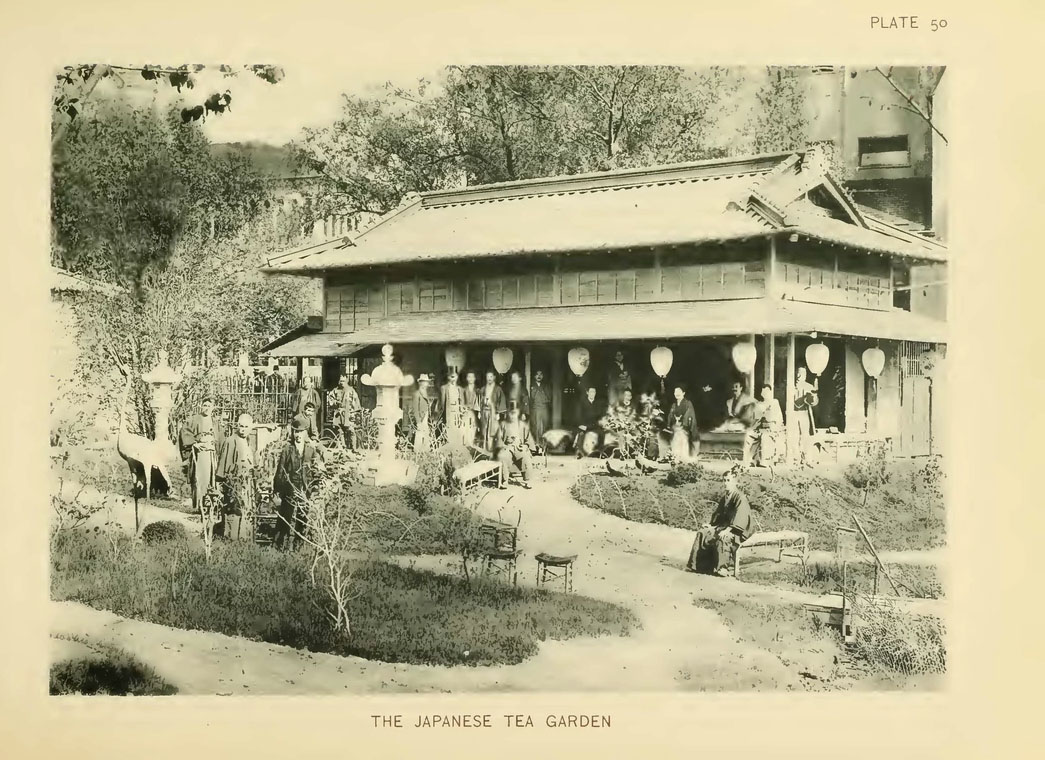
The Japanese Tea Garden. Higinbotham, H. D., and Arnold, C. D. Official Views Of The World’s Columbian Exposition. 2007. (Source: Archive.org)
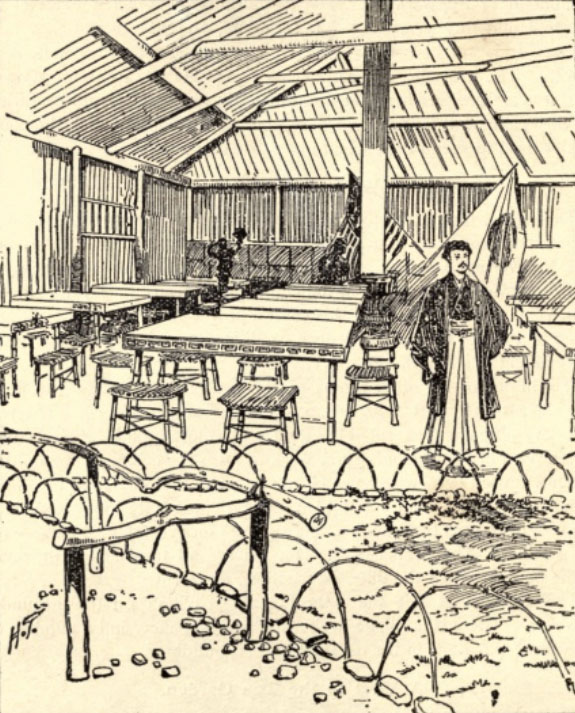
Curiosities from Japan. The world’s fair as seen in one hundred days: containing a complete … Northrop, Henry Davenport, 1836-1909 (Source: Babel Hathitrust)
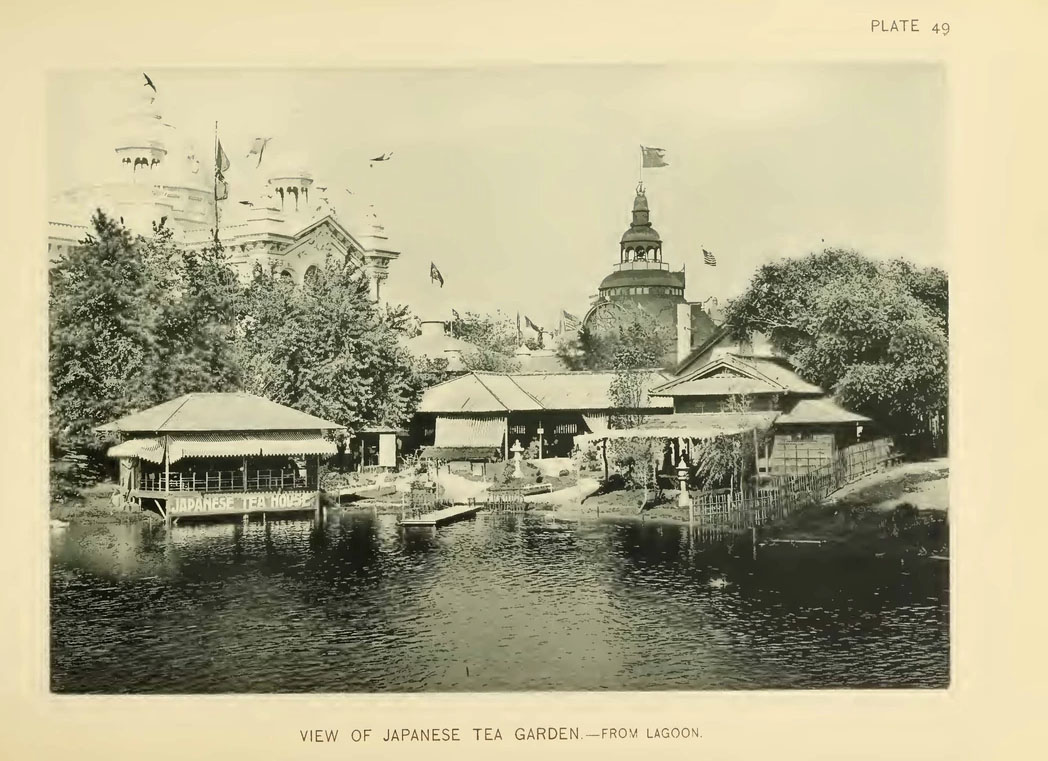
View of Japanese Tea Garden from Lagoon. Higinbotham, H. D., and Arnold, C. D. Official Views Of The World’s Columbian Exposition. 2007. (Source: Archive.org)
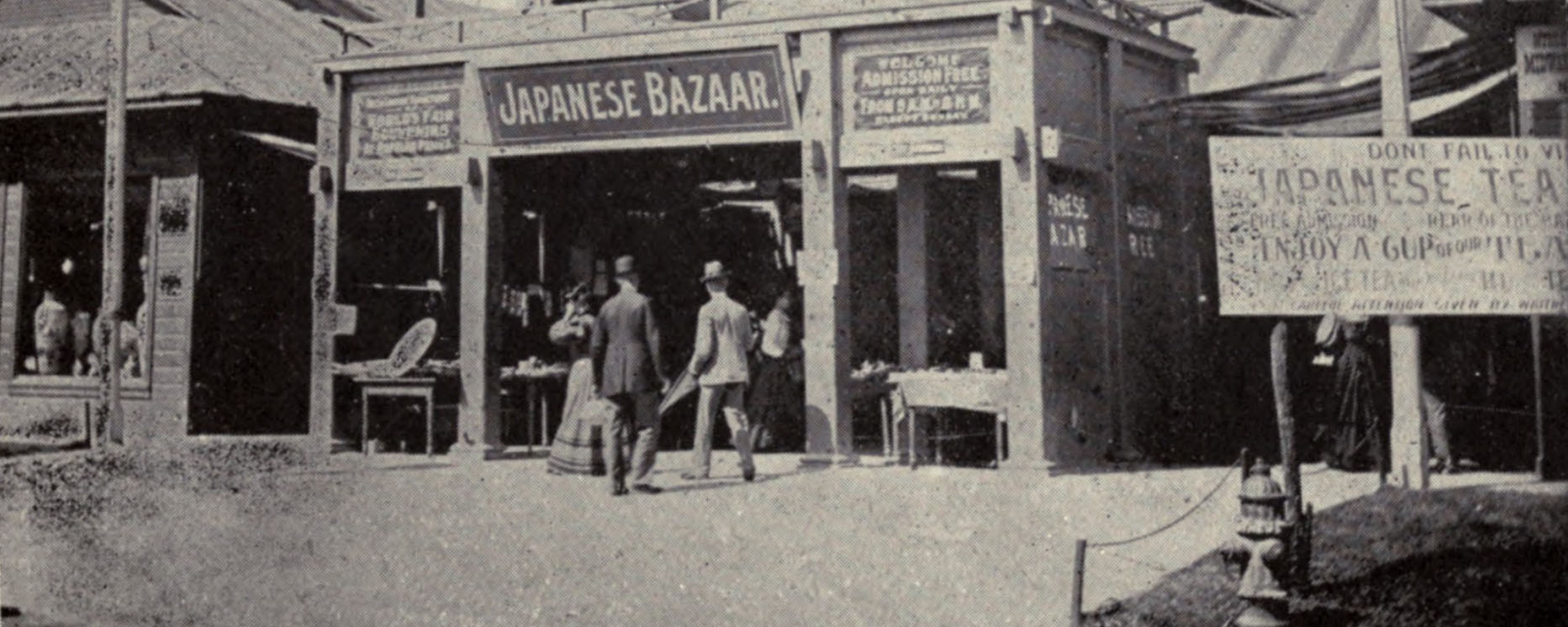
The Japanese Bazaar
Japanese Bazaar. Midway Plaisance.
(Source: Babel Hathitrust)
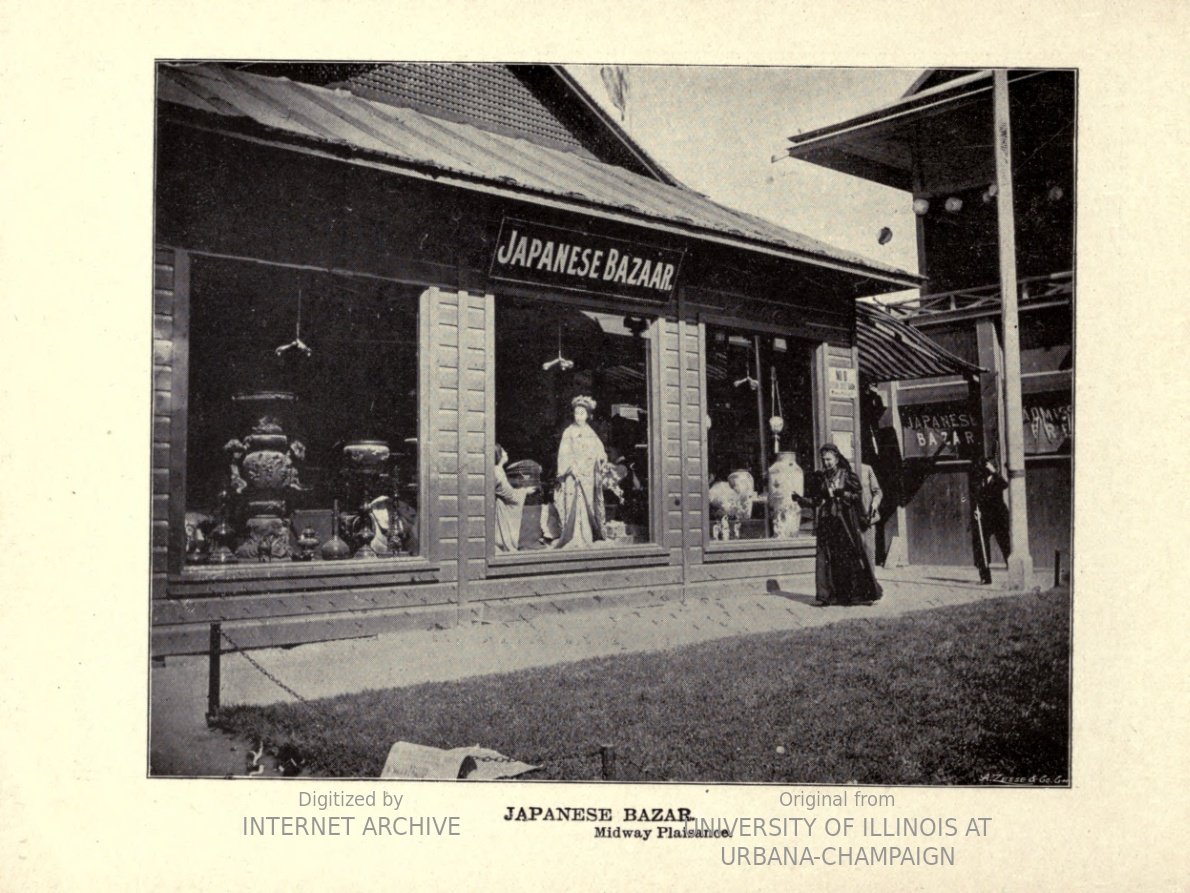
Japanese Bazaar – Midway Plaisance. (Source: Laird & Lee, Chicago. Glimpses of the World’s Fair: A Selection of Gems of the White City Seen Through a Camera. Chicago: Laird & Lee, 1893. Babel Hathitrust)
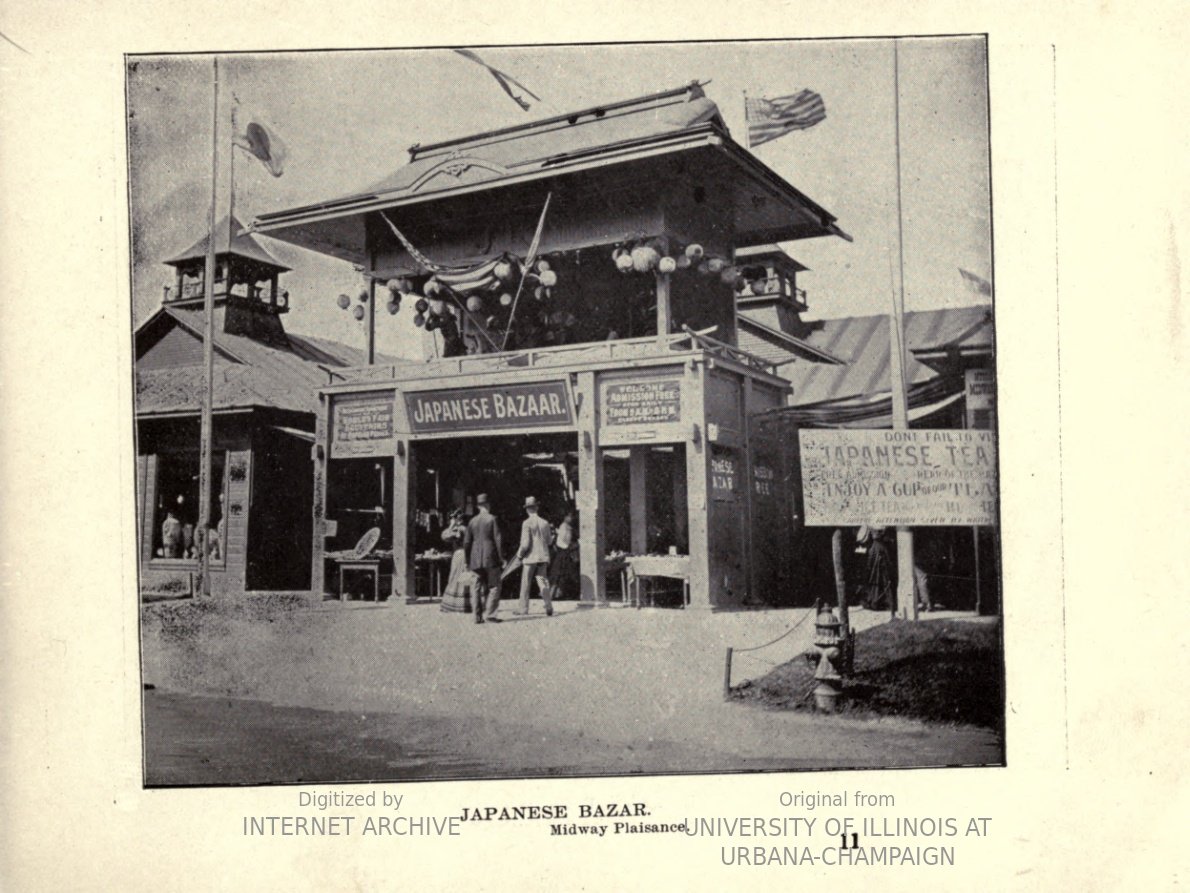
Japanese Bazaar – Midway Plaisance. (Source: Laird & Lee, Chicago. Glimpses of the World’s Fair: A Selection of Gems of the White City Seen Through a Camera. Chicago: Laird & Lee, 1893. Babel Hathitrust)
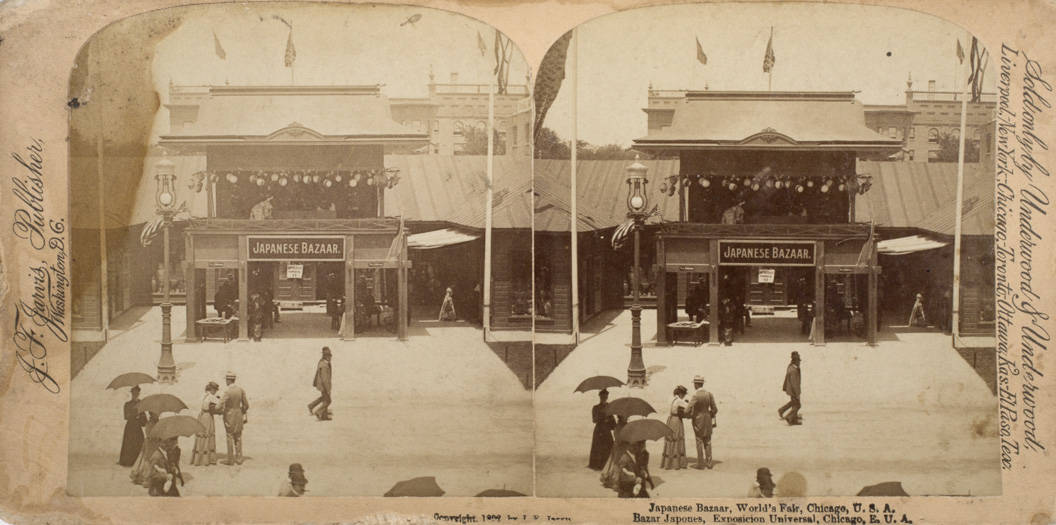
World’s Columbian Exposition, Midway Plaisance, Japanese Village. (Source: The Art Institute of Chicago)
The Japanese Bazaar
At the 1893 World’s Columbian Exposition, the Japanese Village at Midway Plaisance was a place where visitors could take home a Japanese souvenir. It was conducted as a bazaar in the style of a Japanese cottage where goods were offered for sale. The inside was filled with a variety of relatively inexpensive and attractive products, including screens, fans, lacquer wares, iron and brass work.
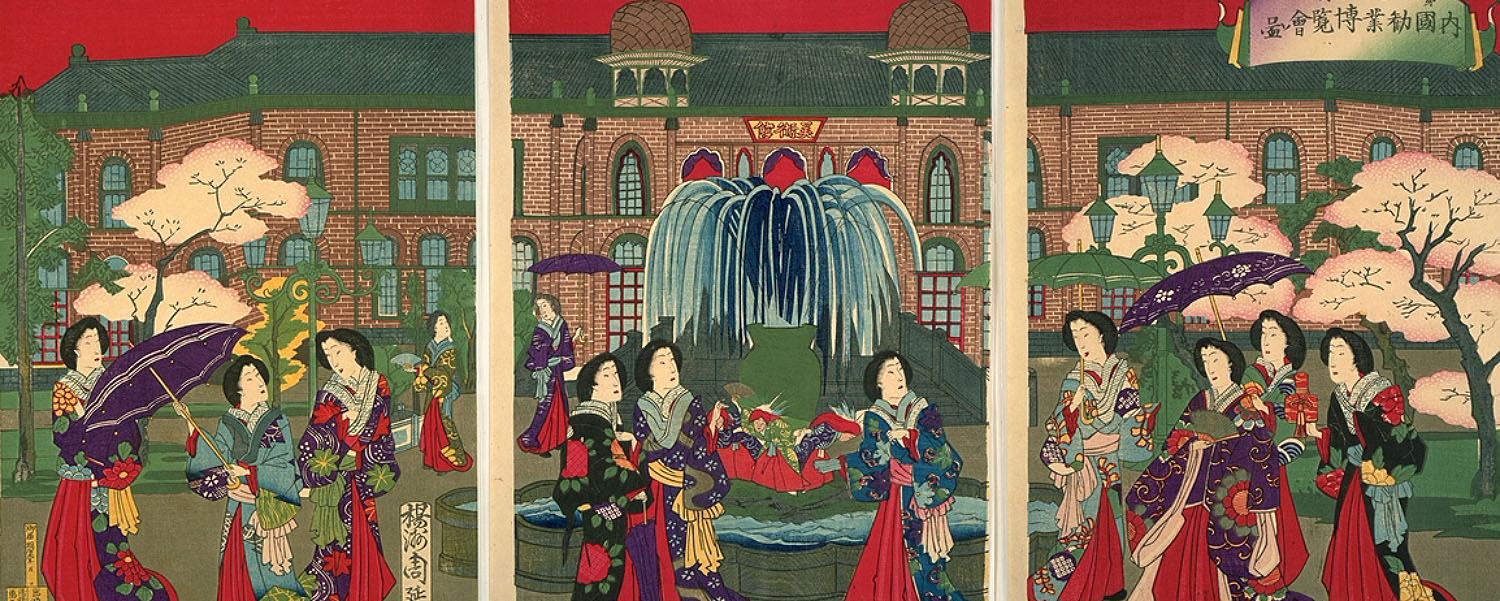
Domestic Fairs in Japan
National Industrial Exhibitions
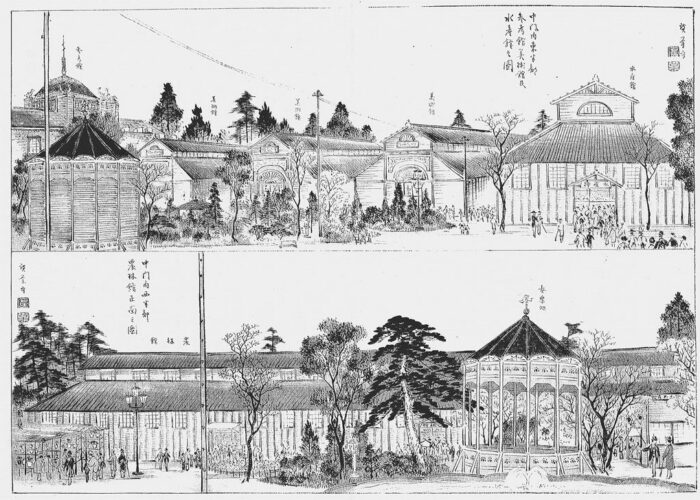
Between 1877 and 1903, Japan held five National Industrial Exhibitions at home. Similar to their international counterparts, national exhibitions presented to visitors a coherent set of architecture that was grand and marvelous. Visible signs of modernization and industrialization dominated the exhibitions, hosted in rotation in the three major cities of Tokyo, Kyoto, and Osaka.
While trying to propagate a historical and traditional image at the overseas fairs, like the 1893 World’s Columbian Exposition, organizers expressed national identity differently at these domestic fairs. The exhibition architecture at home assumed new building styles and emphasized industrial and technological advancements. Main features of the Fourth National Industrial Exhibition of 1895, for example, were the newly-completed Lake Biwa Canal and an electric streetcar.
1890 Third National
Industrial Exhibition in Tokyo
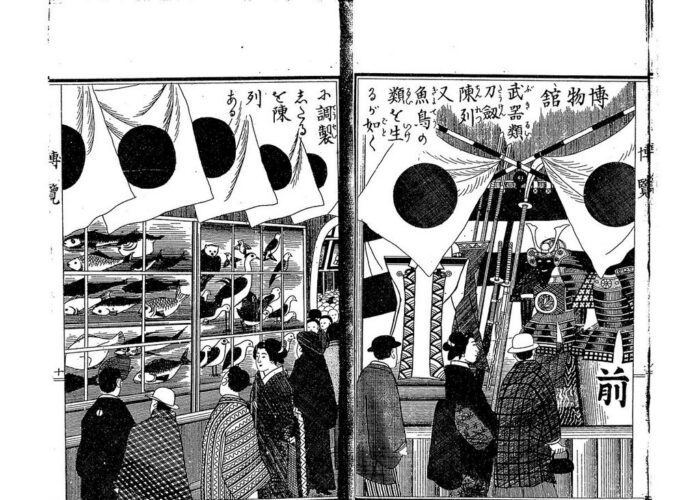 Front Gate. Nijusannen hakurankai jikkyo (1890). (Source: National Diet Library Japan)
1895 Fourth National
Industrial Exhibition in Kyoto
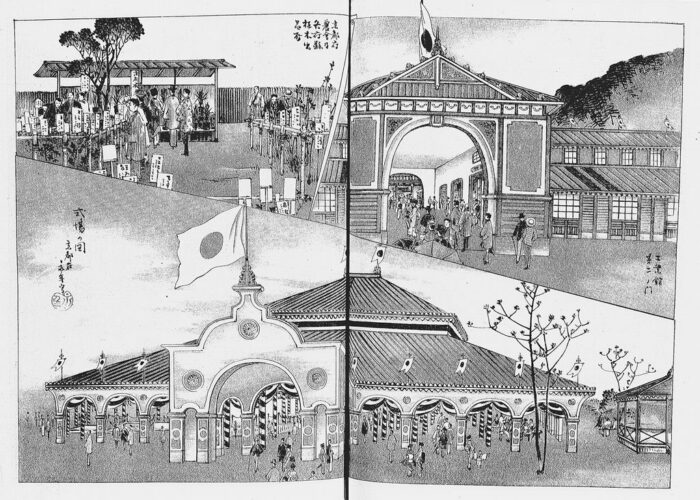 Ceremony Venue (Bottom) and the Second Gate of the Industrial Building (Top-right). Fuzoku gaho n.94 (1895.6.18). (Source: National Diet Library)
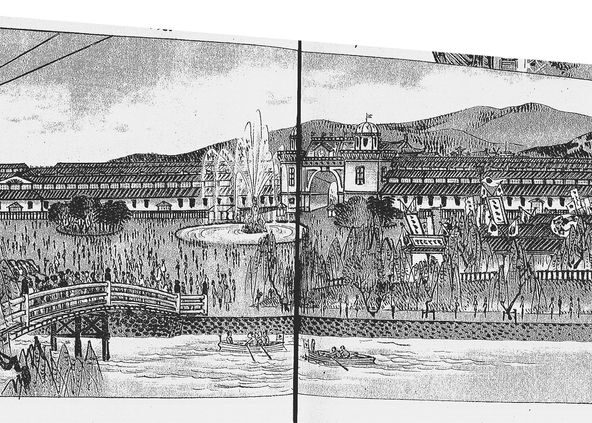
One way to understand the opposing modes Japanese self-representation at home and abroad is exhibition architecture’s fulfillment of visitor expectations and desires. To the average American, a Japanese tea house and a replica Buddhist structure offered great novelty. To the average Japanese, a clock tower and European-style colonnade represented marvels of the new era. As the tourist photography of Japan produced during this time conveyed (see Room No. 1), foreigners preferred seeing the country one way, while domestics lived a more nuanced reality in which the old and the new intermingled.