Asian Voices at the World Parliament of Religions
Room No. 2: The Events of the Parliament
SWAMI VIVEKANANDA
(1863-1902)
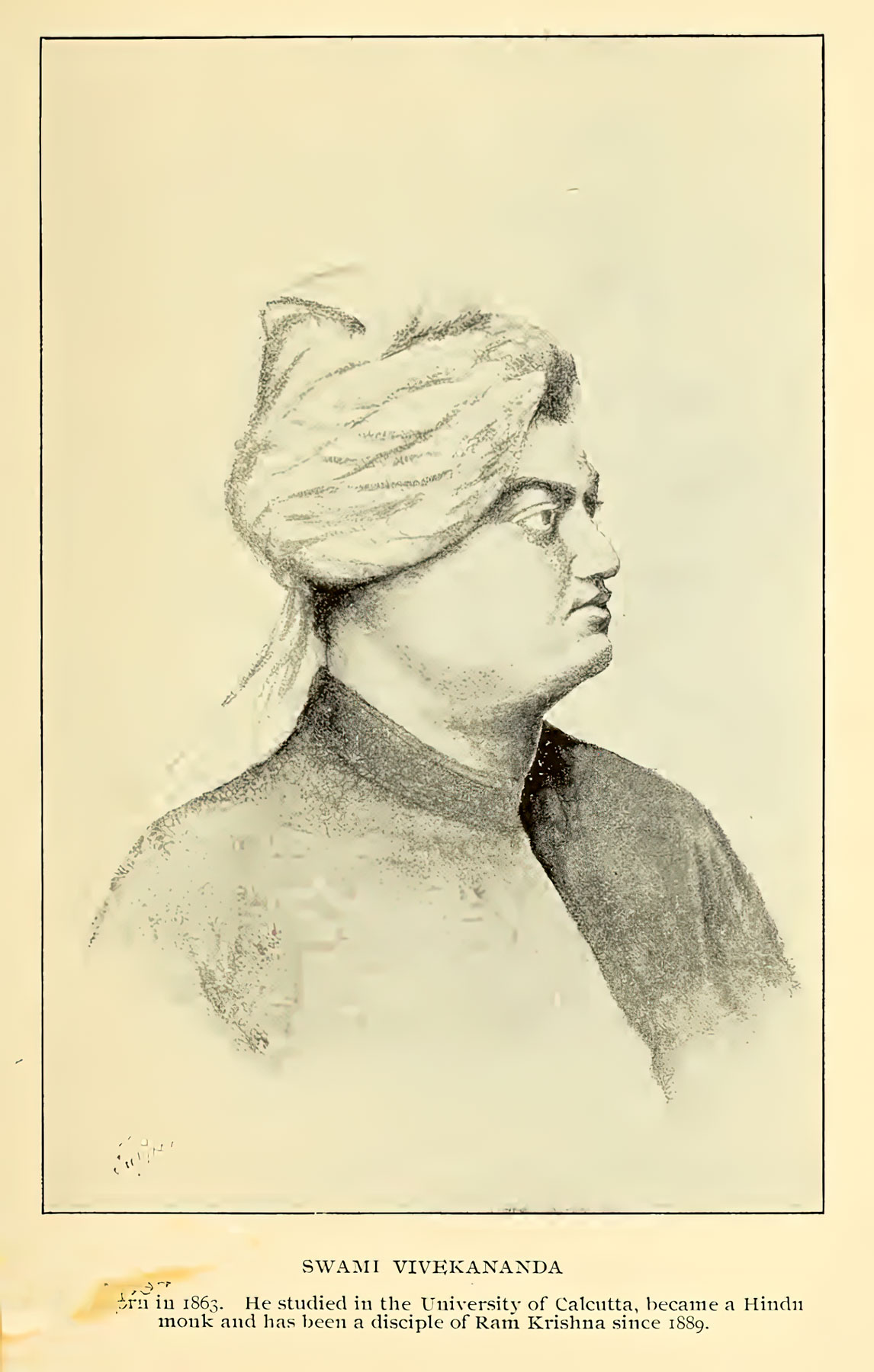
Swami Vivekananda, from C. M. Stevans and H.W. Thomas (eds.), The World’s Congress of Religions (Chicago: Laird & Lee Publishers, 1894), plate following p. 208.
The Hindu swami devotes his address to answering the question of the origin and makeup of the Hindu faith. As he describes, Hinduism is composed of “the spiritual flights of Vedantic philosophy, … the agnosticism of Buddhism, … the atheism of the Jains, … and the low ideas of idolatry with the multifarious mythology.” What, then, reconciles these distinct features and allows them to coexist under the name of one religion? That is precisely the question that the Swami sets out to answer.
He begins by introducing the Vedas, or as he refers to them, the spiritual laws. Similar to Buddhism, the Vedas say that there is no beginning and no end. He extrapolates this idea further, and says that creation has no beginning and no end, for there was and will always be creation and destruction. This cyclical nature, however, does not apply to us as humans because we are not merely our bodies but our souls. For this reason, he declares that our souls were therefore not created, because if they were, they would inevitably have to be destroyed according to the cycle of creation and destruction.
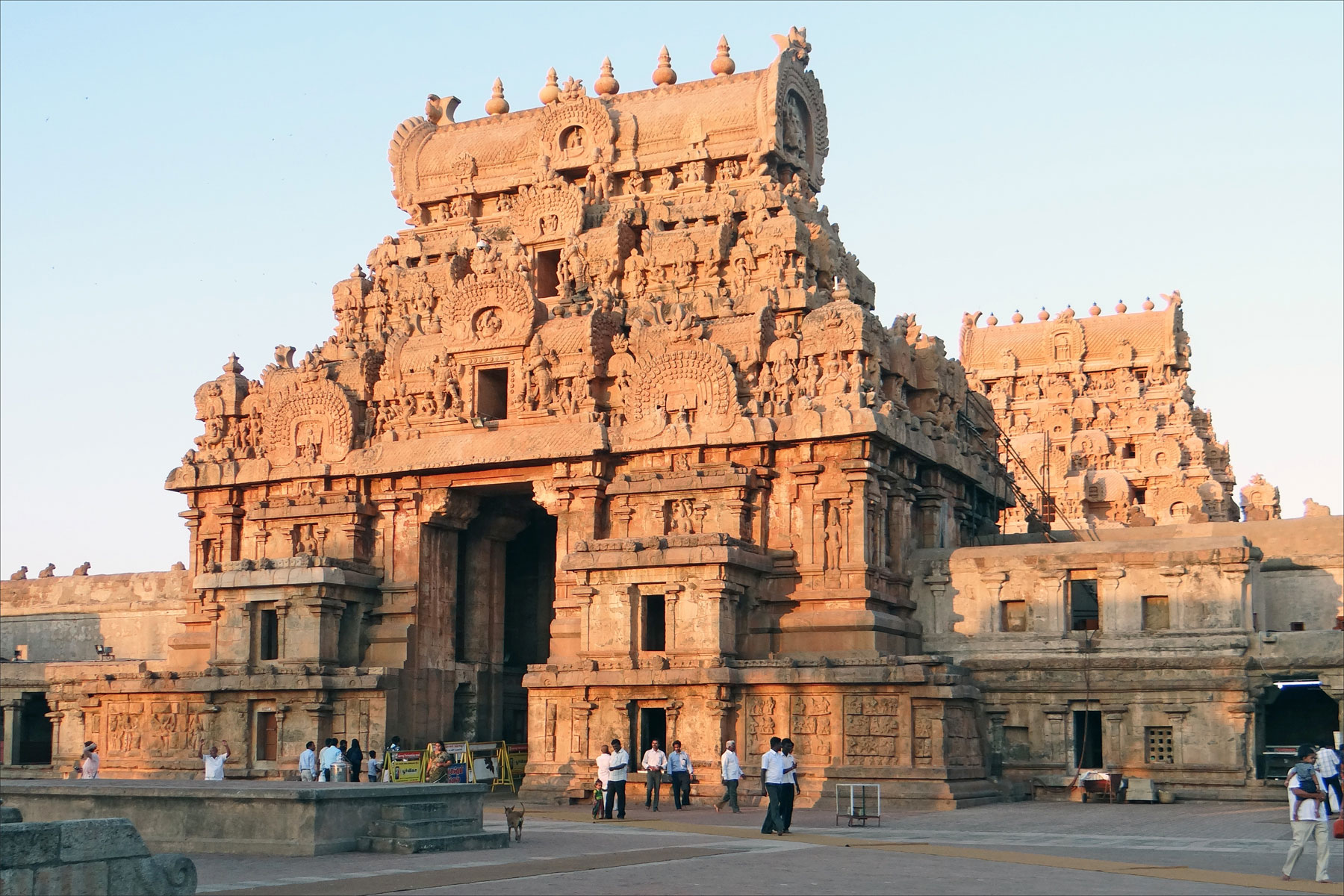
The main gateway of the Brihadishvara Temple at Thanjavur, Tamil Nadu, India. Chola dynasty, c. 1010-1025 CE. (Source: Jean-Pierre Dalbera via Flickr, CC BY).
Our souls, Vivekananda says, are brought about from past lives, and they move from one body to another that is the “fittest instrument” according to the actions of that soul in its past life. These he calls the soul’s tendency, and it helps determine the kind of life that it will lead in the present. This is the explanation for why some people live happy, prosperous lives while others lead miserable ones. It is one of the central doctrines borrowed from Buddhism. The swami also contends that Hinduism, unlike other religions, does not attempt to answer the question of why certain souls end up in certain bodies. He claims that Hinduism puts forth a simple explanation: “We do not know.”
The swami then goes on to address the concept of sin. Quite boldly (considering that the majority of his audience is Christian), he asserts that in Hinduism, it is a sin to label someone as a sinner. As he claims, labeling someone a sinner is “a standing libel on human nature.” One could see how Vivekananda’s intention in highlighting this point out of the many important aspects of Hinduism could have been intended as a form of criticism against Christianity, most likely influenced by his witnessing of Christian missionary efforts in India.
The same could be said of his comments about how love is taught through Hinduism. Krishna, whom the Hindus believe to be an incarnation of God, taught that while it is acceptable to love God in the hope of receiving reward in a next life, all the better to love God for the sake of loving Him. Again, it seems as though Vivekananda is trying to make a subtle comparison between the Hindu doctrine and the Christian Gospel in an attempt to demonstrate Hinduism’s relative altruism.
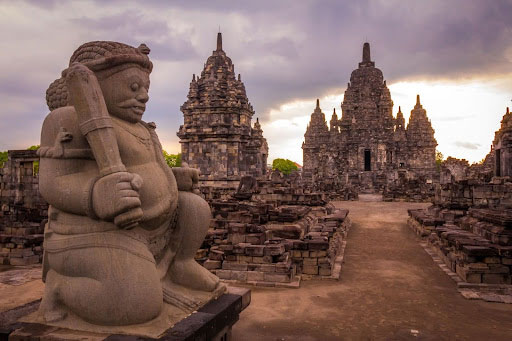
Dvarapala statue at the Buddhist temple complex at Candi Sewu in central Java, Indonesia, ca. 8th c. (Source: AdobeStock)
Man being composed of a soul that is only bound to the human form through matter is a vital aspect of Hindu teachings. The ultimate goal of Hinduism is for man to break from what the swami described as the “terrible law of causation” so that the soul moves from one body to the next. The swami says that only God can relieve one from this eternal cycle, to allow one to bask in the life beyond “ordinary sensual existence.” Therefore, Hinduism does not believe in convincing people to follow a specific doctrine. Rather, it looks to convince by the realization of the soul, and therefore of God. In order to realize God, the Hindu strives for perfection and “to become divine.” This, the swami proclaims, is what constitutes the religious beliefs of Hinduism.
Finally, the way in which Vivekananda concludes his speech is also quite fascinating and worthy of consideration. After speaking profusely about Hinduism’s acceptance of all types of individuals, whether they be poor or wealthy, Christian or Jewish, he leaves the audience with an image of a star. He says:

“The star arose in the East; it traveled steadily toward the West, sometimes dimmed and sometimes effulgent, till it made a circuit of the world, and now it is again rising on the very horizon of the East, the borders of the Tasifu, a thousand-fold more effulgent than it ever was before.”
Through this, the swami cleverly uses scientific natural law to imply that the East and its presence is being felt far greater now than ever before. When reading this, one gets the sense that the swami sees the prominence of the East elevating at the expense of the West as the star revolves back around the Earth and rises again in the East.
This competitive aspect of the Parliament, the dichotomy of East and West, was deeply woven into the speeches presented by the Asian delegates without being overly explicit. Additionally, the fact that the swami uses a natural phenomenon like the rising and setting of the stars to describe this transition is also telling. It would seem as though the swami sees it as a natural occurrence, that the rise in popularity of Eastern beliefs, religions, and philosophies is entirely beyond the realm of human intervention.